Showing posts with label museum. Show all posts

Sunday, 20 January 2013

10: Museum of Childhood


V&A Museum of Childhood
Cambridge Heath Road, London, E2 9PA
Visited on Sunday 20 January 2013

If the media hype is to be believed only the most intrepid would have ventured out onto the treacherous pavements of London on a day like this – but, unfazed by the powdery snow, I and my Russian friend Anna of the Karenina sallied forth to the V&A Museum of Childhood in Bethnal Green for the final culturecake visit of the project.

The Museum has existed in its present incarnation, ie focusing on childhood, since the 1970s, but it was originally built in the late 1860s. It’s a very interesting building – the whole exhibition space is one huge oblong room, with a very high arched ceiling, which looks a bit like the inside of a Victorian railway station. The floor is notable as it consists of a pattern done in mosaic – by the female inmates of Woking Gaol apparently. The layout is interesting too because the central part of the room contains the gift shop and the café, with the actual exhibition items set on two raised floors around the edge.

Notable ceiling and floor

We decided to begin upstairs and work our way back down to the café, but I don’t think it really would have mattered. The exhibits are presented in a very old-fashioned way – large square glass cases with shelves inside, set in long rows. The only other museum I’ve seen like this recently is the Pitt Rivers Museum in Oxford (shrunken heads!). The Museum of Childhood shares another aspect with the Pitt Rivers – it’s pretty dark, so that when you’re looking into the cases, you cast your own shadow over the things you’re looking at. This is not the best really, and made me realize that even though they can seem gimmicky in places, museums that have modernized actually show off their items much more effectively.

The layout also seemed a little bit haphazard. They did manage to group some similar items in the same place, so most of the dolls houses were together for example, but one or two were dotted among other things and there were a few random cases of miscellaneous items that seemed to be outside of the scheme altogether.

Rehearsing for a possible career change

Malevolent beings that come alive in horror films and your nightmares

The vast majority of the exhibits are toys and so there is a fair amount of scope for nostalgia as you wander around among the toy animals, board games, zoetropes, robots, puppets, toy cars and trains, dolls and figurines, and a whole world of miniaturised domestic equipment, including vacuum cleaners, lawn mowers, tea sets, twin tub washing machines, irons and kettles. I found myself saying ‘Oh my god! I used to have one of those!’ fairly frequently, though as this is very much a collection of British items, Anna of the Karenina didn’t come across many items from her own childhood. There was a rather lovely set of Russian dolls however, which was pleasing, as well as a couple of Russian teddy bears.

Ruskie bears

We found ourselves reflecting on how the toys we favoured and games we played with them as children connected with the activities and ambitions we have now. Both of us, it seems, were interested in the toys that were like people – ie dolls or action figures – and made up dramas for them that would absorb us for hours at a time. Miss Karenina leaned more towards real family life in her stories, whereas I got wrapped up in florid medieval tales of chivalry and warfare in mine (I had a big set of Lego Knights). But essentially we were both interested as children in how people relate to one another. It has continued to fascinate me as an adult, though it’s something I’m more likely to muse about over a glass of wine than act out using little figurines and a gory version of some Arthurian legend. (God what a dork I was).

Having fun in the sandpit

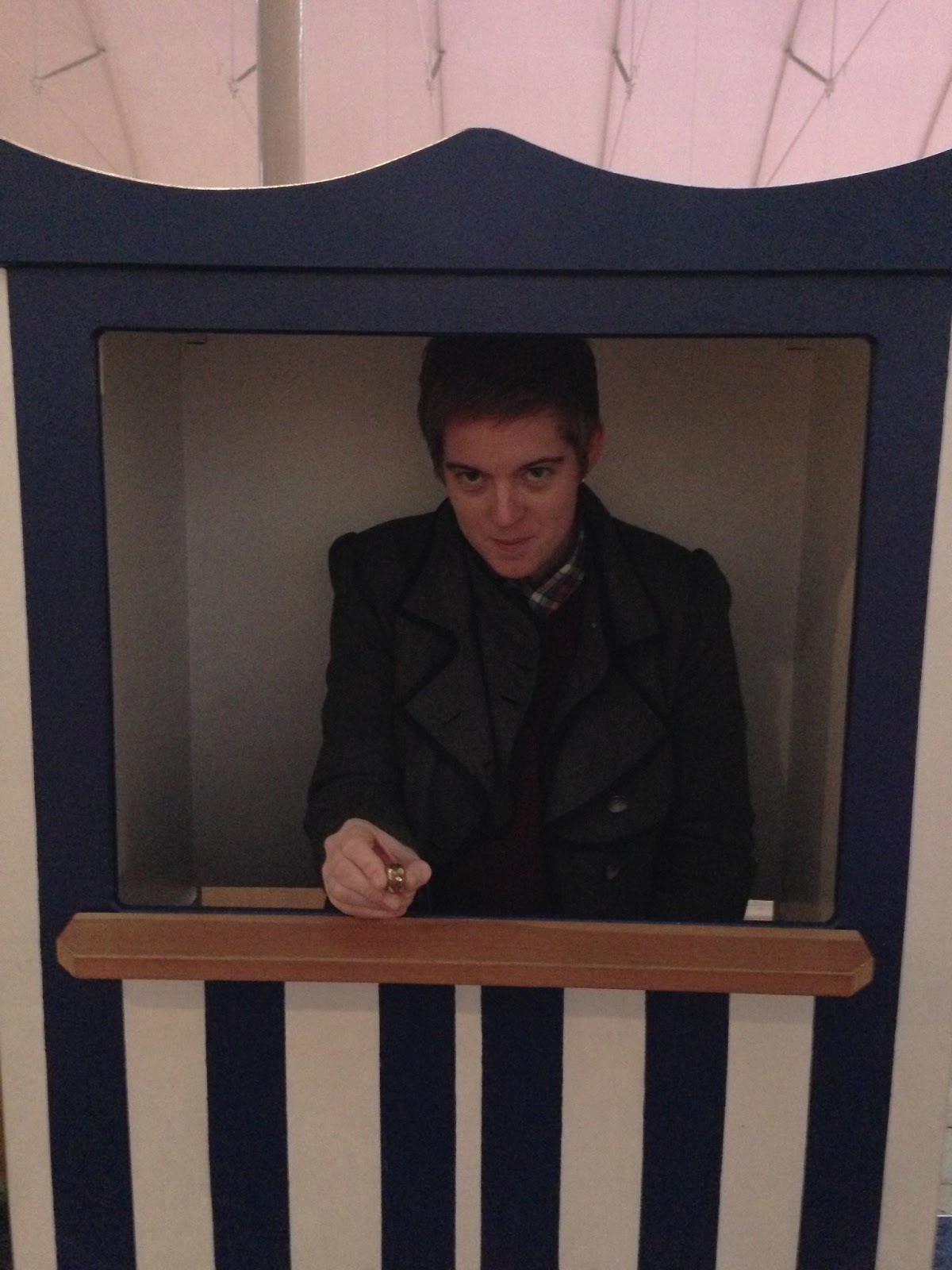
Punch and Judy aka Pato and Sure

It was also interesting to observe what kinds of things have been produced as toys. One lovely item at the beginning of the exhibition was a bus conductor’s outfit, complete with leather shoulder bag and little machine for punching tickets, dating from the 1940s. The kitchen and cleaning equipment, plus the little prams, pushchairs and baby dolls seem designed to ensure we are rehearsed from our earliest days in the ways of adult domestic lives, while Action Man, toy guns, little tanks and fantasy goody and baddie figurines are perhaps intended to get us ready for the darker side of being a grown up. There was also a huge array of puzzles and craft items, plus board games to encourage us to compete nicely together, and visual wonders such as kaleidoscopes to feed our imaginations.

As A of the K observed, it’s almost impossible now for us to imagine what goes on in the mind of a child, or to remember what it was like when we were children ourselves. At one point we stopped to watch a little girl murmuring away to her two little dolls, quietly asking them where they wanted to sit and then explaining to them why their choices were good or bad. It was heart-warming, but also triggered very distant memories of a time when it was OK to devote one hundred percent of your attention to such a scene because there simply weren’t any other responsibilities in life.

Sure

For the competitive among us

It does seem to me that the Museum of Childhood is missing a trick in the way it’s laid out. By organizing the items differently they could generate a much more powerful narrative about childhood, and provoke some interesting thought about it. Setting up a route through the museum by date would enable them to show how developments in technology have affected toy manufacture and design, and illustrate more clearly the ways in which play has evolved as the role of children in society, the expectations of them, and the expectations children have of the world have changed. There were very few information boards, and the collection as a whole doesn’t seem to be actually curated – I much prefer a museum where the collection is presented to me in a way that makes me think, where parallels are drawn between exhibits or where I’m invited to make associations between one thing and another. They could easily do this without compromising the simple joy of seeing loads of toys, which is clearly what the children coming to the museum are excited by.

Some of the exhibits, particularly the older ones, were downright creepy – the puppets especially – but, despite the clunky layout and old-fashioned glass case presentation, most of it was rather charming. Both of us very much enjoyed the dolls houses, and I loved the trainset and miniature village. A of the K was pretty taken with the rocking horses, which were in use by some miniature humans, egged on by cooing parents. It’s worth pointing out that there are of course a lot of real live children in the museum, so if you are averse to these creatures and their periodic squawks and yelps I don’t recommend you come here!

I loved this!

Not sure what's going on here

Designed to scare the living shit out of small people

After a proper and thorough look around everything, hunger took over and we made for the centrally situated café, which is in fact a branch of Benugo. Basically this means that everything is pretty expensive. But it’s rather nice being in the middle of the whole museum, and the various little kids toddling around are funny to watch. At the table next to us was a mischievous little beast of a one-year-old, who managed in the split second that both his parents’ heads were turned to dispatch a ceramic cup onto the tiled floor (smash), followed not long after by its saucer (louder smash). The waiter came over to sweep up wearing a resigned expression – I guess this kind of thing happens all the time – while the baby looked at us with innocent wide eyes and a composed mouth as if to say ‘ummm, yep, it wasn’t me’.

Anyway, onto the refreshments.

Hole-filling if not mind-blowing

Chocolate cake and cappuccino with English Toffee syrup (A of the K)
“This looks dry but it isn’t! It has the consistency of a brownie in fact. The icing is delicious. I’d go so far as to say it’s one of the best I’ve had of its type. Coffee also delicious. 9 out of 10.”

Tuna baguette, pear and blackberry cake and a latte (thepateface)
“Aaargh, eyes bigger than stomach… But, yeah this is ok, nice ‘artisan’ bread, bit sloppy to eat though. Cake has an unexpected ginger flavour and is a bit crumblier than I’d like. Coffee is very bitter indeed. Generally all ok – I was hungry so it’s done its job – but not hugely impressive for the cost. 6.5 out of 10.”

Nice conversation and more entertainment from the not-so-innocent innocent on the next table followed food consumption and then it was time to go home so we forgot to go back to the shop. We’d had a quick scan earlier though and it seems to contain lots of activity items and little toys for children. I didn’t see any postcards, though I might not have looked hard enough.

After a long wait at the bus stop along with a mad drunk and three unutterably posh girls, the 254 finally pulled up to take me back to my lovely warm flat, and afforded a 20-minute ponder on today’s visit, and on the project as a whole. The Museum of Childhood was all right, not spectacular, though it’s kind of fun to see items in front of you that you haven’t even thought about for decades – and to look at toys from other eras. As for the culturecake project, I’m really glad I chose to do it, though I visited far fewer places than I thought I would over the three months. It’s certainly re-ignited my interest in museums, galleries and places of interest, and though the official project ends here, I imagine I’ll be making further contributions in the coming weeks and months. Thank you again to A of the K, Brother B Man the Mystic, MinustheMatt, Charlie, Brother Neil and of course little brass face himself, Sure, for joining me on this journey of pleasant cultural discovery.

Monday, 3 December 2012

3: Geffrye Museum


136 Kingsland Road, London, E2 8EA
Visited on Sunday 2 December 2012

Since I moved to Stoke Newington, I have taken the bus to work down the Kingsland Road most weekdays. Once you get through the hectic bottle-neck that is Dalston, the bus stops at a very attractive building called the Geffrye Museum, a converted 18th-century almshouse of the Ironmongers’ Company. It contains a fascinating series of rooms fitted out in the manner of middle-class British living rooms from 1600 to the present day, and calls itself a museum of the home. This visit – to see the Christmas Past exhibition – was prompted by Anna of the Karenina’s penchant for Yuletide happenings and general affection for the season.

Pleasantly simple tree decoration

The layout of the museum is very straightforward, dictated of course by the design of the original building – you walk from one end to the other passing through rooms containing furniture and décor from particular bygone eras. Each one is arranged as a tableau and a little board on an easel describes what’s going on, as if the people who live there have just popped out for a moment. Between these scenes are rooms containing typical museum cabinets of items such as plates, paintings, chairs, lampshades and so on, with interesting information boards. There is a good balance of things to read and things to look at. For the Christmas Past exhibition the curators have adorned each of the rooms with seasonal decorations of the time, and created scenes to depict what would have been happening in them, which also explain the origins of our various festive traditions.

Informative notice

Indeed, comfortable

Sure takes a break

We were immediately struck by how un-Christmassy the rooms from 1600 to the mid 1800s were. This is because most of the things we now associate with Christmas – decorated fir trees, holly, mistletoe, cards and sparkly decorations – only date from the Victorian period. The Christmas tree custom, for example, became popular with the general public following the publication in 1848 of illustrations showing the Royal Family standing around their decorated tree. The actual tradition seems to have come to Britain earlier than that though, imported in the 1780s by Queen Charlotte, George III’s wife, from her native Germany. Christmas cards were invented by an Englishman, Sir Henry Cole, who in 1843 came up with the idea in order to avoid having to write long letters of seasonal greeting to his many business and social contacts. With the introduction of a cheap postage rate for unsealed envelopes and postcards in the 1870s, card sending dramatically increased. It seems the postal system was a little more efficient then than it is today, as apparently when they said ‘post early for Christmas’ they meant ‘get it in the post by Christmas Eve’!

Delighted by the 1850s Christmas vibes

Sure gets involved with the other toys - can you spot him?

The rooms from later periods, particularly those from the decades of the 20th Century, contained items and scenes more familiar to us. In some ways these rooms are more interesting anyway because by the time you get to the 1930s, most of the items you’d find in a living room of today (sofa, bookcases, tv/radio etc) are present, and it’s rather charming to see recognisable pieces in old-fashioned styles.

Mindful that museum visitors require sustenance, the Geffrye Museum people have built a rather good extension to the building, which contains the café. Unfortunately, we arrived too late to sample its goods, though we did have a good look at it and concluded that the crockery is tasteful and the space itself is very pleasant. It smelled of cinnamon and the cakes we were too late to eat looked good! Though it was dark when we were there, the windows all down one side of the room probably afford a rather nice view of the gardens during the daytime. [I told Brother B Man the Mystic about our visit and he said he’d overheard a most interesting conversation on the bus between two ladies who’d been there – apparently the gardener is really helpful and gave some excellent advice on growing herbs out of season].

The last part of the exhibition consisted of a Christmas tree to which we were invited to attach a Christmas wish. Some of these were rather strange: ‘I want to meet more famous people next year’ being my favourite. Sure brought his irrepressible positivity to the proceedings, of course.

Sure can do anything good at all times

Christmas wishes

The shop was not bad – it’s quite small, but had some nice books, and some festive finger puppets, which pleased A of the K. Not as much as her biography though. We both bought nice postcards.

Caption not required

Given that we’d missed out on the café within the museum itself, we decided to go into Shoreditch in search of coffee and cake. This is a fairly fruitless mission at 5pm on a Sunday. Nonetheless, we took a pleasant walk down Brick Lane and through Spitalfields Market, finishing up at Patisserie Valerie. Cakes aplenty, obvs.

Caaaaaaaaaaaaakes

The waitress was pretty grumpy, but we sat in comfortable red leather armchairs while we waited for her to bring us our latte, cappuccino, apple juice and sweet foods.

Post-culture feast

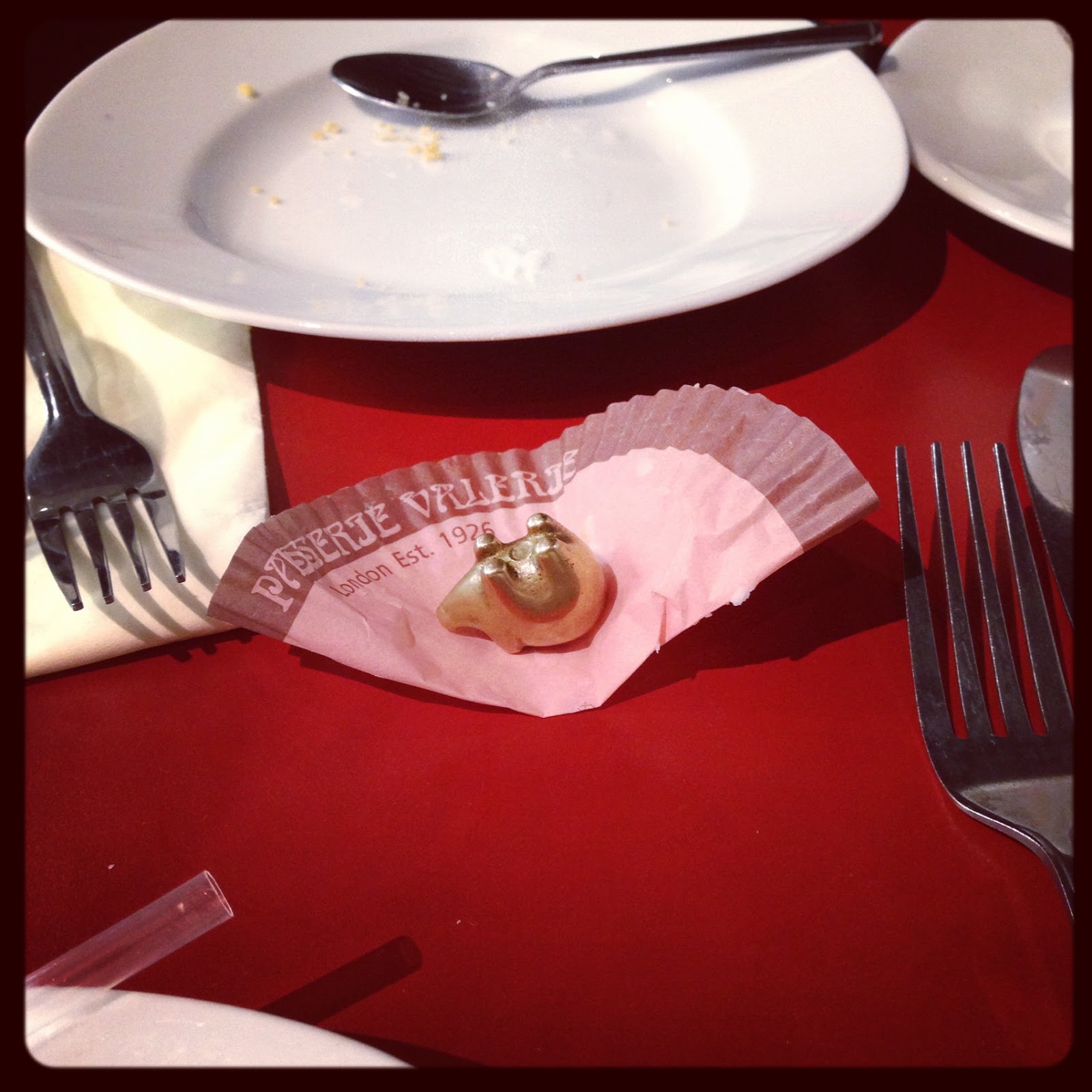
Over-indulged pig

Almond Marzipan cake (Anna of the Karenina)
“Oh my god, I love almonds. The topping is amazing, but hmmm, the inside is a bit, you know, *makes slightly ambiguous hand signal*. There is a questionable layer of jam, and the pastry is a bit dry. But I would still give it a 7 out of 10.”

Apricot Danish (thepateface)
“Very aesthetically pleasing, with an enjoyable layer of icing on top. Very tasty jam within. Slight dryness to the pastry, but it is 6pm and it was probably made this morning, so I will let them off. 7.5 out of 10. Oh wait – having eaten through to the middle section I see they have omitted to place an actual apricot there, the presence of which I had falsely been led to expect following the visible apricots at either end. Slightly vexing. I’m downgrading to a 7 out of 10.”

The coffees were served in very wide cups that were as big as soup bowls (French) and the drinks were pleasant, though not mindblowing. That’s fine. £13.80 for the lot seemed fairly reasonable given the nice ambience and general quality of the goods.

Sure is revived following his sugar overload

On the whole it was agreed that the Geffrye Museum is definitely worth visiting once. We suspected that the café might be a draw in itself, particularly if you’re in the area on a Sunday afternoon and fancy a nice cup of tea and a view of some gardens. It’s probably on the whole more interesting for grown ups than children, and there is a bit of a congestion issue if it’s busy – something that is apparently to be addressed by a £16.3m development project, due for completion in 2015. The museum’s website has some nice photos and a virtual tour. It does also say that although they accommodate corporate events, the building and grounds cannot be hired out for weddings. I know of at least one person reading this who will be disappointed!

Monday, 26 November 2012

1: Natural History Museum


Cromwell Road, London, SW7 5BD
Visited on Monday 26 November 2012

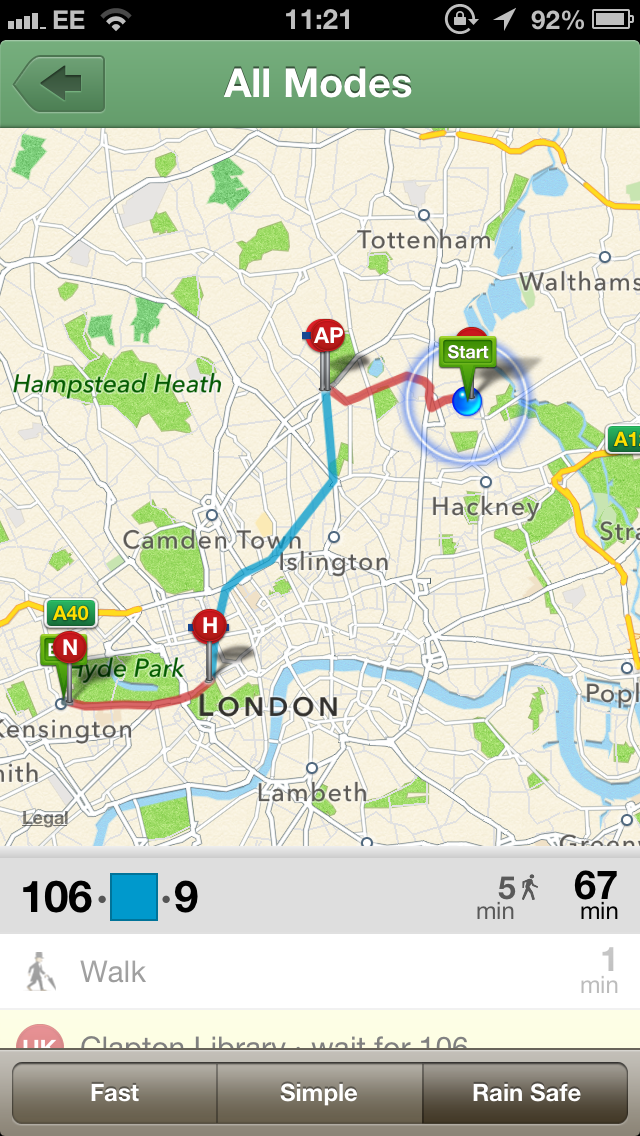
Citymapper app route plan

Today’s route was meant to have included a new bus - the no. 9, which runs between Aldwych and Hammersmith, and would for this journey have taken me from Green Park tube to Kensington High Street. However, most uncharacteristically, I found myself arriving in town half an hour early for the pre-culture meeting (1pm at High St Ken Wagamama with Charlie and Brother Neil) and so I decided to take a walk through Green Park itself and along the road where the 9 would go. This was in some ways a mistake – it took me aaaaaages and it was bloody freezing and raining, however I did get to have a proper look at some of the residences in the area (posh mansion blocks mainly) and noted the number of very large cars. These vehicular equivalents of gigantic tea cakes might protect the quaintly uniformed little darlings as you take them on the school run, but woe betide any unsteady old lady stepping off a pavement at the wrong moment.

So, ten minutes later than the arranged time, I arrived at Wagas feeling like I’d had a few lucky escapes while crossing roads. After a swift nose around Zara with Charlie, who had some choice tops to recommend for the new job wardrobe, we sat down with Brother Neil to enjoy our armadillos of rice, curry sauce and fried chicken (the classic Katsu – number 71 – of course). 

Sure gets stuck in

Over lunch we agreed on the strategy of dinosoars, the whale and taxidermied birds for our route around the Natural History Museum. Our walk there took us past the Gore Hotel, the scene of much revelry following the National Youth Orchestra’s BBC Prom in the summer (the most expensive sambuccas in the universe can be purchased there); and after negotiating yet more Chelsea Tractors and passing people on the street dressed for a splendid afternoon’s grouse shooting, we arrived at our cultural destination.

Companions in the foreground, diplodocus in the background

The Natural History Museum is perhaps most famous for its distinctive Romanesque architecture and the imposing diplodocus skeleton in its grand entrance hall. The dinosaurs exhibition contains many other skeletons (Brother Neil’s favourite was the Triceratops) (here’s a very nice song that makes use of that word in the opening lyrics), as well as several interactive pieces and stuff aimed at engaging young people. There is a metal walkway suspended from the ceiling that takes you through the middle of the room and affords a great view of some of the bigger pieces. It leads eventually to a rather cool robotic Tyrannosaurus Rex, though this is slightly spoiled by the same automated woman who announces the stops on buses telling you every 30 seconds to ‘keep moving down the ramp’. Following the exhibition round back to the main hall we learned a number of good facts:

·      A Pterodactyl is not a dinosaur, it’s a flying lizard
·      The Tyrannosaurus Rex was so heavy that if it had fallen over by accident while running at full pelt it probably would have died
·      Meat-eating dinosaurs grew teeth throughout their life to replace worn out ones

Proceeding to the awesome life-sized model of the blue whale, we also went past many stuffed mammals, including a grizzly bear and a real armadillo (not the katsu kind) that has the brilliant special move of being able to curl up into an almost impenetrable ball when threatened.  We learned a good fact about female deer (they do not have antlers, with the exception of the reindeer) and we also met a relative of Sure’s, which pleased his little brass face no end.

Give's a hug

Real folding armadillo

Boar and Sure

Moving on to the birds section, we enjoyed some models of different dodos (dodi? hm) as well as a pretty majestic-looking vulture, posed as if in full flight, and an excellent display of eggs, which was obviously quite thrilling for me (eggs are one of my favourite things).

Number 6 is a regular hen's egg

There’s a lot to see in this museum, and it’s all laid out very logically, as we noted from the particularly clear and well-designed map. (£1 donation to own). However, owing to that walking-pace one always adopts in a museum (very slow), we were by this point quite tired and decided to leave the rest for another time and move on to the café. This is situated just off the main entrance hall, and is in itself rather grand. 

Brother Neil enjoys a good hall

Lovely cafe ceiling

Good selection of cakes

The array of cakes was impressive and, as Brother Neil pointed out, there was ‘ample and comfortable seating’. Service was perfunctory but not actually rude, and three cakes plus two pots of tea came to £14.85, so it’s not cheap. We did feel that given this, the bendy plastic cutlery on offer was not really acceptable (though it did give rise to Brother Neil’s sagacious observation that ‘the pen is mightier than the plastic fork’). 

Unacceptable plasticware

Anyway, the teapots were a nice shape so we weren’t too miffed, and the surroundings were very pleasant indeed. Regarding the cake and tea:

1) Millionaire’s Shortcake with marbled chocolate top (Charlie)
“I’m really pleased with it. We have well-proportioned elements (biscuit, caramel and chocolate topping), the slice is a manageable size, it’s very aesthetically pleasing, and the caramel is chewy but not too gloopy. 8.5 out of 10.”

2) Chocolate fudge cake (Brother Neil)
“Mmmm, it’s dense. Good sponge-to-filling ratio. Generally speaking it’s a good bake with consistent edges. I’d give it 8 out of 10.” This was updated about 15 minutes later however: “I have detected unexpected dryness towards the end. I’d like to downgrade it to a 7.”

3) Traditional Bakewell tart (thepateface)
Disappointingly dry, but good flavours, and again well-proportioned elements. The texture does let it down though. 5.5 out of 10.

4) The tea (all of us, two pots being enough to go between three)
Brother Neil poured first and there was some minor drippage, though this was not the case when Charlie poured from the other pot. It was duly noted that Brother Neil’s technique might have been the cause of the issue. The tea itself was delicious and we were pleased with the ponciness of the teabags – they are the sort that you can use to put loose tealeaves into, thusly permitting their appropriate movement within, but not their invasion of, the water and leading to a nigh-on perfect brew. Very refreshing!

Poncey but very pleasing teabag device

The SHOP was the final part of the visit, and we were impressed by its size. It contains the usual items – stuffed toy dinosaurs, jigsaws, branded stationery, little polished rocks and lots of books. The postcard selection wasn't huge, but we all bought some very nice ones, and I also bought a lovely little book about pigs. By chance I flipped it open at page 72, on which there was a photo of a tin of Spam. Sure was not so pleased about that.

Following this very nice diversion and a general agreement that the Natural History Museum is a really good place to visit, we decided to conclude our excursion with a glass of wine at a pub near the tube station. By this time it was dark and we were delighted with the fairy lights in the trees outside the museum, and a pleasantly lit-up carousel. All very nice.

Outside the museum

Owing to the tiredness, I decided just to sit on the Piccadilly line all the way from South Kensington to Finsbury Park, even though this wasn’t the quickest route home. It was a strange journey. Firstly there were three 6- or 7-year-old girls dancing around the pole in the middle of the carriage and making a right old racket. Two of them were slight and very active, and the other was quite a bit larger. It was a rather sad moment when the two skinny ones pointed out that the other was ‘too fat to climb up the pole, cos you’re too heavy’ and her Dad had to step in and say ‘No, no, she’s just tall’… the poor girl stood back and let the other two get on with it, wearing a really quite heart-breaking, crushed half-smile on her face. Then a gigantic woman got on and sat beside me, muttering aggressively to herself and digging me repeatedly in the ribs. I tried to ignore it, but it all got very awkward when we pulled in to Covent Garden station – she ended up missing her stop because she couldn’t un-wedge herself from the seat in time and, worst of all, the little girls started pointing and laughing at her. Kids can be pretty cruel I suppose.

After a short wait at Finsbury Park, the good old 106 brought me home. This is a bus route operated by especially advanced drivers, the ones who have the special skill of judging that exact moment when you’re halfway down the stairs and you’ve lifted your hand off the upper rail to grab the lower one – at which point they slam on the brakes. It’s so annoying that it’s impressive. So I ended the day with what is likely to become a small bruise on my forehead, but very happy nonetheless. Thanks to my companions for a wonderful start to the culturecake project – Brother Neil, Charlie and Sure the pig.