Friday, 18 January 2013

9: Triple bill! La Bohème, Les Mis and The Minotaur


La Bohème at Hackney Picture House
Visited on Tuesday 15 January 2013

Les Misérables at Hackney Picture House
Visited on Wednesday 16 January 2013

The Minotaur at Royal Opera House
Visited on Thursday 17 January 2013

Since I haven’t written for a while, and as this is to be the penultimate contribution to the culturecake project, I thought I’d go for an unprecendented ‘three in one’. It has been a week of culture consumption bordering on the extreme as I’ve been spending the daytimes doing my revision on opera and ballet in preparation for my new job that starts on Monday, while three consecutive evenings have seen me heading out for some kind of musical / theatrical piece of entertainment.

The first was Puccini’s La Bohème, on Tuesday night. I’ve seen the opera only once before – almost 20 years ago at the Oxford Apollo, when Welsh National Opera visited. I don’t remember too much about it, except for thinking that the final scene where Mimi succumbs to her illness and dies her frail, tiny, cold little death was a bit difficult to believe given the robust corpulence of the soprano playing the role…

Tonight’s performance was a ‘delayed live’ relay from the Royal Opera House, ie it was recorded live last week and we were watching the unedited footage from that. There are some significant advantages to watching a performance like this in the cinema: for a start the cost of a very comfortable, modern seat is £20 and you can take your wine in with you; at the Opera House proper, the same view would cost you about £165, the seat would be narrow and apparently designed for the sole purpose of giving you backache, and there’s no way the apparently deferential but actually Nazi stewards would let you into that auditorium with a glass of anything. Additionally, at the cinema you get the ROH’s Music Director Antonio Pappano on the screen before it starts to give you a plot summary and to tell you all sorts of interesting things about the music and staging and so on. The disadvantage is that you don’t get the magical atmosphere of being in such a grand place as the Royal Opera House, with its poncey staircases and people dressed up to the nines and interval drinks that cost the same as food to feed a family of four for a week. The nice thing about the ROH’s ‘wear what you like’ policy is that you can go along in jeans and still get to hang out with people in fancy outfits who make you feel like you’re part of a posh and special experience.

Anyway, there was none of that at Hackney Picturehouse, although thankfully there was a gentleman in the audience who was of that sort, if you know what I mean. When the opera started there were no subtitles on the screen, Sir Ponce took it upon himself to stand up and boom ‘SHALL I COMPLAIN?’ – to which general assent was murmured and lo, within minutes the subtitles had appeared and we were spared having to watch 2.75 hours of Italian opera with no translation.

To be honest, I do wonder whether it would have mattered. Puccini’s music is, as well as being generally lush and gorgeous, quite consciously descriptive of the words it sets. Combined with some properly excellent acting from every member of the cast, we probably would have been fairly clear about what was going on even without subtitles. This production, directed by John Copley, has been around even longer than I have – it was first staged in 1974. It’s easy to see why the Opera House hasn’t changed it in those 38 years. 1830s Paris is wonderfully evoked by the detailed sets and costumes. The staging (which mainly involves the draughty apartment shared by the four student artists Rodolfo, Marcello, Schaunard and Colline) is presented on multiple levels, and there’s always something to look at and lots of opportunity for interesting movement by the singers.

I have always thought opera plots were a bit far-fetched – I mean, really? You really fell in love after gazing at each other for about 30 seconds and exchanging a couple of well-executed high notes? Obviously though, you have to suspend quite a bit of disbelief for this artform and rely on the talents of the director and musicians in the pit and on the stage to make that easy for you.

As an example, La Bohème (The Bohemians) starts with the four chaps bantering and generally horsing around at their apartment, bemoaning their poverty with mock-drama and silly antics. When his chums head off to the pub, Rodolfo is the only one in to answer the door to poor Mimi, whose candle has gone out so she can’t see her way up the stairs. Rodolfo swoons over how lovely she is, there is a bit of flirting, then she drops her key on the floor by mistake and they both fumble around in the dark for it, which results in the fizzing contact of Rodolfo’s manly mano and Mimi’s tiny frozen one, leading to the first famous aria ‘Chè gelida manina’. Over the course of the next 5 minutes, Rodolfo basically sings her his CV, she tells him about how she adores flowers and the smell of spring and then, boom, they are fully in love and pledging never to leave each other. Riiiight.

Yet, from the beginning the absolutely superb quality of the singing and acting draws you right in to the world where such happenings are completely normal. The banter between the four students was heart-warmingly believable, and though it’s set at a time and in a world so different from today, I think most people can identify with that kind of housemate vibe. Dmytro Popov’s portrayal of Rodolfo was such a great combination of honest and subtle that I found myself quietly cheering him on as he poured out his heart to Mimi, even though if a man did this to me only two minutes after us meeting, I’d be quite freaked out by it.

The good thing about this opera is that the story rattles along without any wastage – the economic informational conversations lead to one beautiful aria after another, none of which are overblown. There are glory moments for all the principal singers to show what they can do. Stefania Dovhan, playing Musetta, was brilliant (and slutty) as she sang her famous Waltz aria in Act 2, while provocatively running her hand up and down a pool cue, in her attempt to seduce former lover Marcello (played by Audun Iversen, with a goatee that made him look a bit like Ben Affleck). After various machinations involving either provoked or unprovoked jealousy on the part of both couples, and some jolly slapstick with a real live dog, we get to the closing scenes where poor Mimi’s frailty is now a serious concern. Essentially she has TB, and that, combined with a separation from Rodolfo in Act 3, has precipitated The End. She ends up dying round at the four students’ flat, after they’ve made really touching gestures to sell their own personal items to pay for a doctor and some medicine. Both I and Brother B Man the Mystic were fully and genuinely in tears when Rodolfo, who’d been holding up pretty well, finally turned away from Mimi and started sobbing himself, realising that she was done for. I imagine there’s lots of scope for overdoing this, but it was all the more affecting for being controlled. I massively recommend seeing this production, which is on at Covent Garden until 12 March.

The subject of crying and potentially overdoing it brings me on to Wednesday night, when I was back at Hackney Picturehouse again. This is now my third visit this month, and I’m so glad to have discovered this awesome cinema. There is a really nice bar as soon as you walk in – and there are CAKES, plus a proper menu of very delicious-looking food. If you become a member (£35 for the year) you get a discount on everything and don’t have to pay for online booking. All this is very good. I didn’t intend to go and see Tom Hooper’s new film version of the musical Les Misérables but Joshi Dreams of Sushi (an ace-looking documentary about a sushi chef) was sold out and I thought I might as well see something since I was there. I’ve seen the stage musical twice before – once in Manchester in about 1994 and once when it was still at the Palace Theatre in Cambridge Circus (as part of a most regrettable date). Both times I thought the music was a bit lightweight and that the whole show just seemed a bit flimsy. This film version certainly isn’t flimsy! The cinematography is sumptuously coloured and really spectacular in places, and, unencumbered by the limits of an actual stage, the director is able to use wide shots and sequences to fill in plot gaps that would only otherwise be communicated in the sung dialogue, so that helps the whole thing to feel a bit more substantial.

I was interested in two things about the casting – first that none of the actors are well-known as singers, and second, their vocal performances were captured live at the same time as their acting. This worked really well I thought, lending extra believability to vocal performances that were for the most part very convincing. Russell Crowe was the weak link in terms of singing, honking away slightly out of tune and without quite pulling off the emotion, but the other performances made up for it. Hugh Jackman was great as Jean Valjean, the hard done by bread-thief-cum-slave who makes good after a brush with the Lord and a few bloody decent actions towards his fellow man. His singing voice isn’t the most powerful, but he really, really meant it and it was hard not to be touched by his delivery. Anne Hathaway has the show’s big hit I dreamed a dream, but rather than belting it out Susan Boyle-style, she delivered it like the pathetic, delicate song that it is – and it was so much the better for it. Apparently she starved herself to get thin enough to play the role, and it was genuinely quite heartbreaking to see this skinny, filthy woman who finally crossed the line and let some awful soldier fuck her for money singing so wistfully about the better times she’d always hoped for. The camera boldly stayed right on her, close up, for the whole song and I admit I had a bit of a lump in my throat by the end of it.

There’s quite a lot to the plot – mainly involving some opera-style love at first sight, raucous slapstick from a Cockneyfied Sacha Baron Cohen as the Innkeeper and Helena Bonham Carter playing the slightly mad character she seems to play in every film she’s in, as well as quite a lot of fighting, and some serious undertones about the ghastly conditions that the poor had to endure at the time. It all ends quite triumphantly and happily though – the lovers get together, Jean VJ dies happy, there are revolutionary heroics – and the spirit, setting and acting are all there in this film version. The only thing that let it down for me was the music itself, and you can’t blame the film for that.

However, on this subject of crying. Every review you read of the film mentions that it will certainly make you cry, and there is even a video doing the rounds of some parents in a car saying they cried more at this than at some relatives’ funerals. I almost felt obliged to bloody well cry as soon as the film started. I do find this celebration of weeping pretty irritating though, as it seems to devalue the specialness of things that genuinely make me shed a tear. Anyway, the trendy boy sitting next to me had definitely received the memo because he started blubbing about 10 minutes in and barely stopped for the remaining 2 hours and 27 minutes. There were short pauses every couple of minutes or so for him to rustle around, fidget and then stuff another fistful of stinking peanut M&Ms into his Shoreditchly-moustachioed face, before one of the characters would get watery-eyed or sing something – anything – and he was off again. Honestly. I do recommend the actual cinema though – the film, yeah sure, it’s definitely worth a go, and really you don’t have to feel like you’re being an ice queen bitch if you don’t cry, I promise.

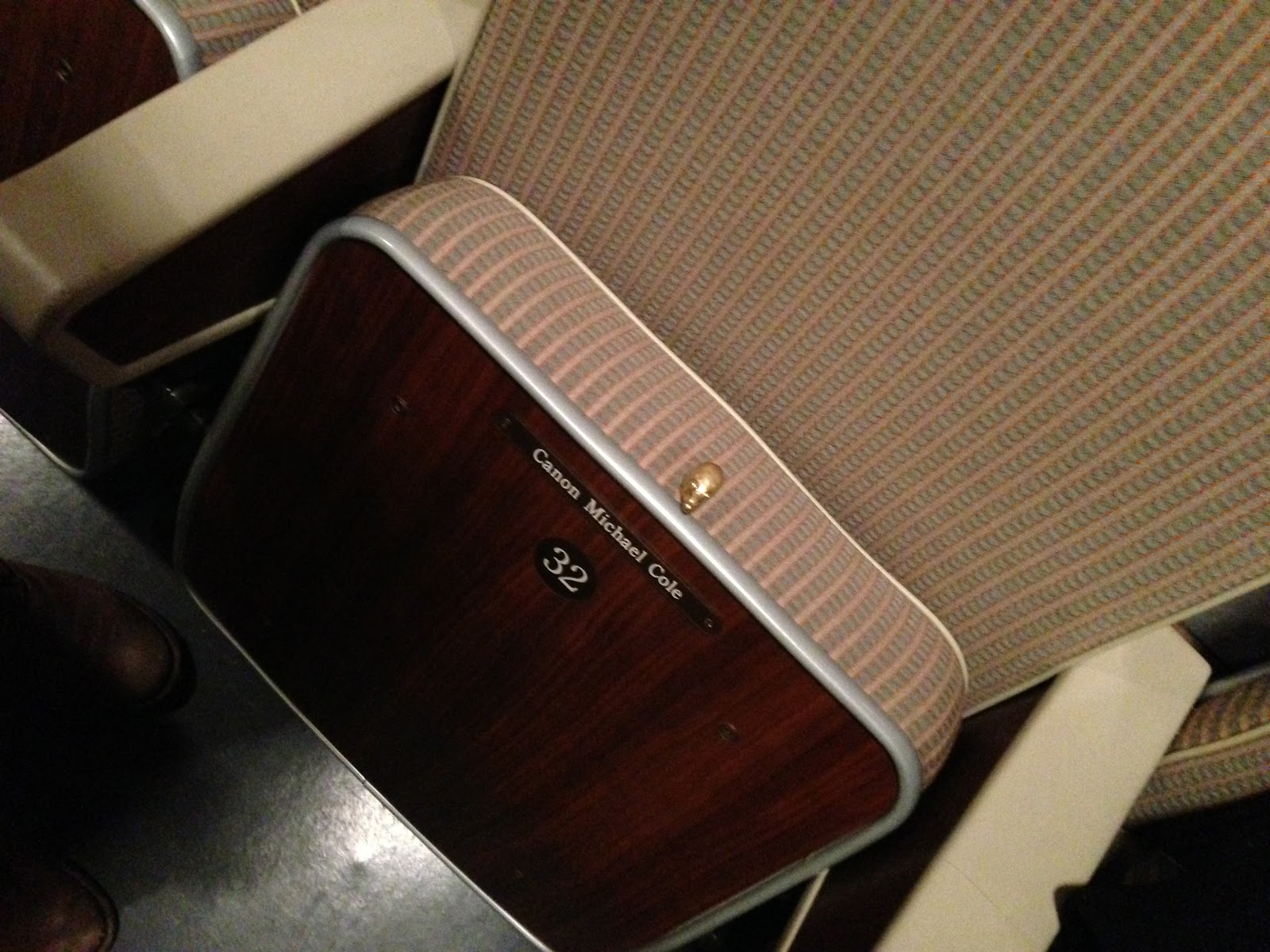
Thursday night was certainly not a weep-fest. I’d bought a pretty expensive ticket to the Royal Opera House itself to see the first night of Harrison Birtwistle’s 2008 opera The Minotaur. I wanted to see what it was like to have a really good view and be among some of the posh people (rather than practically touching the ceiling and only able to see 20% of the stage!). The opera tells the story of Asterios, the half-man-half-bull incarcerated in the labyrinth by King Minos of Crete, and to whom a sacrifice of ‘innocents’ – young men and women from Athens – is made every year. One year Theseus decides he’s had enough of this and comes over from Athens with the intention of killing this Minotaur once and for all.  The opera begins with Ariadne sitting on the beach, musing about the horror of the innocents coming over to be slaughtered. The staging is pretty sparse, but it does a great job of taking you away from any association with the modern world. You are transported to a time of myth, where strange and horrible things happen, but you accept them because there’s nothing to make it seem out of context.

After a bit of chat between Ariadne and Theseus, the innocents descend ladders into the labyrinth and the scene cuts to the middle of it, where the Minotaur stands, surrounded by a taunting Greek chorus in masks. It’s all a bit frightening. The innocents come in and the Minotaur rapes and gores them one by one, before a horrid troupe of Keres (kind of death-eater type creatures) swoop in to devour their remains. Nice. The Minotaur is tired after all his gorey-rapey action so he takes a nap and we see him dreaming. It was at this point that the opera really came alive – in his dreams Asterios believes he can speak, so we get to hear the brilliant John Tomlinson actually singing rather than just making anguished moo sounds. What I wasn’t prepared for was how sorry I would feel for the poor creature. To be fair, he was born out of a pretty dodgy situation: King Minos wanted to prove that he was the legitimate king, so he asked Poseidon (sea god) to send him a sign. Poseidon sent a white bull from the sea (sure), which Minos was to sacrifice. However Minos was so pleased with his white bull that he kept it. Poseidon was fuuuuuuriously angry to be disobeyed and as revenge made Minos’s wife develop zoophiliac desires towards the bull. She then persuaded some other guy to make her a cow suit and seduced the white bull into having sex with her. The issue was the Minotaur – half man, half bull. Shunned and rejected, full of lust and anger, neither fully man nor fully beast, and not great to look at either, poor Asterios has lived his life in torment, all the more so because the Oracle advised Minos to stick him in this horrible labyrinth underground. He dreams of the world above that he vaguely remembers, and wishes he was dead, or loved. It’s actually really sad.

Thankfully at this point it was the interval so I nipped across the road to the pub (most of the pit orchestra were there already) for a stiff drink. In the second half, Ariadne goes to visit a transvestite high Priestess with a pedantic assistant to ask for advice and they give her a big ball of red twine that she is to supply to Theseus so that he can enter the maze, paying out the twine as he goes, and use it to find his way back once he’s done in the evil freak. Before the ultimate fight scene we see the Minotaur dreaming again, and Ariadne does some slightly disturbing sex poses to a) demonstrate what her mum did with the white sea bull and b) try to seduce Theseus and persuade him to take her away from this horrid island. As you can guess, things end badly for the Minotaur as Theseus stabs him to death. In death, as in sleep, Asterios can speak, and, despite what I said about this not being a weep-fest, his final pathetic farewell had me fairly close to real tears.

Things then got quite jolly as there was rapturous applause and at the end of the curtain call – at which composer Harrison Birtwistle, librettist David Harsent and conductor Ryan Wigglesworth were present (the latter was a couple of years below me at University… he’s certainly made a more glamorous career for himself than I have!) - Tonys Hall and Pappano came on stage with a nice cake to present to John Tomlinson to celebrate the fact that 35 years ago he made his ROH debut. There was a lot of clapping to do.

I spent the journey home thinking about the very different events of the past three nights. I loved La Bohème, and Les Misérables was pretty exciting, but I think it was actually The Minotaur that touched me the most. It’s unlikely in a way: though expensive, my seat wasn’t hugely comfortable, and the person next to me was snoring all the way through; the music itself was almost impenetrable – not a single tune and no rhythms to hang onto; the story is bleak and tragic and there was a lot of blood violence and creepy wraith things eating people’s hearts; and the human characters are not very nice people – they all have a selfish agenda and say a lot of airy fairy stuff without really connecting. However, the libretto is absolutely beautiful – if I hadn’t worried that the stewards would cut my arms off for doing it, I would have whipped out my iphone at several points to note down some of the lovely, poetic lines. John Tomlinson’s singing was a huge highlight too – in his speech Tony Pappano mentioned the singer’s reputation for perfect diction and it was well-demonstrated here. His costume was also excellent, and his acting even better. Overall it was his depiction of this wretched beast that really got to me – much more than the expiry of dear Mimi or the many thou-shalt-now-cry moments in Les Misérables.

As mentioned, the culturecake project is nearing its end, or at least this phase of it is. Thank you to the kind companions who’ve joined me for my trips out. The last one will be on Sunday, when hopefully I will actually take some photos, and perhaps write a little bit less…


Monday, 7 January 2013

8: Saatchi Gallery


King's Road, Chelsea, London, Greater London SW3 4RY
www.saatchi-gallery.co.uk
Visited on Friday 4 January 2013

Today’s journey began in Dalston as I was there for an appointment, and so I was able to get straight on the Overground to Whitechapel and change for the District Line to Sloane Square. It was a pleasant journey, taking me unexpectedly round the back of the previously visited Geffrye Museum, and thus affording a very quick look at the gardens there (nice but bare, it being winter). There was virtually nobody on the train and I got to the destination in about 30 minutes. If you don’t live in London be warned – this is in no way typical of a journey on either of those lines!

The Saatchi Gallery began life in 1985 in St John’s Wood. Opened by renowned recluse, ad man and art aficionado Charles Saatchi in order to show his private collection to the public, it has received and indeed courted quite a bit of controversy over the years. Saatchi effectively launched the career of Damien Hirst, when he put on his famous show of Young British Artists in the early 1990s (featuring Hirst’s shark in formaldehyde piece), and provided a springboard for many others such as Rachel Whiteread, Jake and Dinos Chapman, Sarah Lucas and Tracey Emin. Her piece ‘Everyone I Have Ever Slept With 1963-95’ (‘the tent’) was lost in a fire at a storage warehouse in Leyton containing several other pieces owned by Saatchi, as well as many other artworks. The total loss was valued by one insurance specialist at over £50m. Indeed.

Anyway, the gallery now has its premises within the very splendid Duke of York’s HQ. Done up for the purpose and opened in 2008 it is undoubtedly one of the best gallery spaces I have been to. The fifteen white-walled and high-ceilinged rooms are light and airy and provide a serious but quite neutral context for the artworks displayed in them. Unlike other modern art galleries (such as the Tate Modern), where you have to pay to see the special exhibitions, everything here is free – except for the little exhibition guidebook, which maddeningly I seem to have mislaid somewhere between lunch and home (that’s what daytime wine does for you kids – just say no). Anyway it was only £1. There was a stack of free copies of the gallery’s own magazine ‘Art and Music’ in the foyer so I had a flip through one of those while awaiting today’s companion, the Lady Anonymous…

Dramatic entrance

There were two exhibitions for us to see - ‘Gaiety is the most outstanding feature of the Soviet Union’, and ‘Breaking the Ice: Moscow art 1960-80s’. Together the two bring together works by about 40 Russian artists and we saw many pieces, so I will just give some of the highlights here.

The first gallery contained large black and white photographs of Soviet prisoners. They were all men, stripped to the waist (and beyond in some cases) to reveal their tattoos. The photographer, Sergei Vasiliev, had worked for a local newspaper, then got a job as a prison warden. His colleague had begun cataloguing the prisoners’ tattoos as the imagery contained subversive messages about the Soviet regime, and about the prisoners’ own crimes. When the KGB got wind of this, they realized that these DIY tattoos – made using improvised sharp edges and ‘ink’ in the form of blood or urine – could provide useful information, and so they sent in Vasiliev to make a visual document. The photos are immediately striking because the men have been quite deliberately posed – sometimes on their own with props, sometimes seated in pairs or groups with their arms over each other’s shoulders in comradely fashion, and sometimes looking directly at the camera with a very intimidating stare – these are portraits rather than merely technical pictures. The tattoos themselves are surprisingly intricate and well-executed, given the tools available. They are mostly images, though there are some words too – we couldn’t make out much of this as they use the Cyrillic alphabet, but there was a bit of Latin I did recognise on one of the men: Dum Spiro Spero, which means ‘While I breathe, I hope’. (In one episode of the BBC drama series Spooks, the character Lucas North returns from seven years in a Russian prison, where he had also been tattooed with this motto).

Don't mess
 
Moving on, we came to a room containing a line of what looked like cubicles or stables made from cardboard. Inside each one was a dummy of a man wearing suit trousers and business shoes, but his head was a colourful abstract shape, and his shirt was filthy and ripped. Each man had a different injury but all were brutal – arms missing, or a hand ripped off and pinned to the wall. The figures were cartoony enough not to be disturbingly gruesome, but also real enough to be quite unsettling. The artist, Gosha Ostretsov, is apparently a big fan of comics, which, we learned, ‘have not been assimilated into Russian art in the same way as they were by Pop artists in the West. In fact, they are still considered somewhat alien and certainly not the medium with which to convey anything serious. Ostretsov has knowingly subverted this received idea by co-opting the resistance to comics and pop culture, using them as a colourful, mass culture form “[to polemicize] with the profound, rather heavy-handed conceptualist approach”'. Sure. Quite good though.

Criminal Government - Cell 999
Kind of grim, really

Vikenti Nilin’s ‘From the Neighbours’ series of photos was one of my favourites in the exhibition. The shots feature ordinary people seating on windowsills in desolate-looking high rise apartment blocks, but with their legs on the outside, as if they might jump at any moment. The buildings and clothes are drab, but, despite their precarious positions, the people are passive in this potential suicide situation, which I think is the point the artist is trying to make. You might joke that living in one of these utterly commonplace, totally uninspiring Soviet block of flats might make you want to top yourself, but these people seem to have no drive to do anything, not even that – they are bored, uninterested, slightly unimpressed. It’s a simple concept I suppose, but the I found the message affectingly direct, and the camera angles and composition gave me that same feeling you get when you're close to the edge of high cliff.

From the Neighbours Series
Suicidal, or just bored?
 
In the next room we came across some lovely paintings. They were mainly large cavasses, with very small, ghostly figures gently positioned in the middle. They had an ethereal quality to them and were plain creepy too in a way – they compelled you to look, but the figures depicted were reminiscent of something that might be in a dream at that point when you know it’s going to accelerate into a nightmare. It made me shudder a bit, but I couldn’t help looking.

Untitled
Spooky but lovely

By far the most disturbing set of pieces – but in a way my favourite part of the whole exhibition - was a series of photographs by Boris Mikhailov, showing homeless people in the Ukraine. It was stark and direct. The people are known as ‘bomzhes’ – those who have no home or support. The artist states that he wanted to capture them while they still were ‘normal’ and still looked human. The implication that they were changing into something less-than-human owing to their appalling living conditions and alienation from society was deeply depressing. Many of the people were posed naked or half-naked and there were a lot of unpleasant genitals on show. Most of the subjects were looking directly at the camera, and the expressions on their faces were in some ways unfathomable, but in another way quite simple – accusatory and pleading. As viewers we felt almost guilty, as if we were the ones who’d put these people in this destitute position. The sexual poses were quite hard to deal with, perhaps because it was a difficult reminder that these people are indeed still human, and still have the same basic drives that we all do. 

Case History
Totally massive sure right here

The next gallery was a bit of a surprise as it seemed to be art from Hong Kong, therefore not part of the exhibition we were working our way around. We had a look anyway, and I particularly enjoyed the enormous wooden tank. Sure was also a fan of this item but there were too many people around to get a decent shot of him with it.

Bonus tank
 
On the top floor we found the Breaking the Ice: Moscow art 1960-80s, which contained some really interesting pieces, although we were pretty hungry by this point, so we skipped over quite a bit of it. Nonetheless, we did spend quite a bit of time looking at the series of paintings and lovely little illustrations by Viktor Pivoravov and the impressively large works of [did not write down and thus don’t know artist’s name!].

Good space

Nice letter-y thing

Pivovarov's 'Black apple'

Stalin meets Giacometti

Ironic

After all that it was time for lunch, so we decided to try out the rather posh-looking ‘Gallery Mess’ restaurant, which is situated just next to the exhibition space. This was something of an extravagance as it was not cheap, but we felt we ought to treat ourselves, since we had quite bit of catching up to do, and it was a Friday. So, any excuse really.

Very pleasant restaurant space
Look at that VERY BIG SHOE Mummy. (only one person reading this will get that joke)

Somewhat extravagant lunch

Salmon fishcake on wilted spinach (Lady Anonymous)
‘It’s good. Pretty tasty. I guess fishcakes are quite a boring thing to choose, but it suits my needs at this time. The crumb-to-filling and fish-to-potato ratios are perfect, and the spinach is excellent. Frankly this is one of the best fishcakes I’ve ever had and I’m going to give it a 10.’

Duck breast with lentils and pesto (thepateface)
‘This is super-delicious and the pesto is a stroke of genius. I’m loving this thin and elegant cutlery. Probably didn’t need quite so many lentils but there are some bits of something very tasty mixed in, which I am enjoying immensely. Portion size is exactly right. 9.5 out of 10.’

The high marks do reflect the price we paid, but we enjoyed very nice service and overall the atmosphere in there was very pleasant – light and airy like the gallery, with some added super posh people having a conversation worth eavesdropping upon at the next table (“Well I said to him, if you insist on slumming it then go ahead and move to N16, but know that I don’t approve of this’). Charming. A slight air of condescension was detectable in the waiter later on, but that might have been because we were still there at 4.30pm, taking our dessert in the form of red wine.

On the whole it was a lovely day out. I’d very much recommend the Saatchi Gallery in general, and particularly the two exhibitions we saw. Though there is a lot in there that’s just nice or intriguing to look at, there is some tough stuff as well, so I’d say go along if you want a little bit of a challenge. And that restaurant is certainly worth dipping into your savings for!

Thursday, 20 December 2012

7: Kensal Green Cemetery


Harrow Road, London, W10 4RA
www.kensalgreencemetery.com
Visited on Wednesday 19 December 2012

I have always been fascinated by what goes on behind the ‘presented’ parts of London. Those narrow back streets or railway yards or waste grounds that you don’t see from the main road seem to have an air of dilapidated and abandoned beauty to them. If you don’t know what I mean, try taking a train on the London Overground. As the name implies, this is a set of routes that make up the London suburban network and most of the stations and lines are above ground. It was established in the mid-2000s more as an exercise in branding than anything else, bringing together existing services operated by a disparate group of rail companies by giving the stations consistent signage. As of 9 December this year, the network has been fully joined up, and is largely located in Zone 2, allowing you to travel horizontally across London in a way that’s not really serviced by the Underground. Trains snake their way past ordinary people’s back gardens and round the back of big buildings, taking the traveller on a journey through the unglamorous, functional parts of town. Tube trains rumble beneath these areas too, and buses crawl along the traffic-heavy main roads but it is only really on the Overground that you get to see London backstage.

I had never been to Kensal Rise before, though it’s only 25 minutes on the train from Dalston Junction. The destination was Kensal Green Cemetery, one of London’s ‘Magnificent Seven’ cemeteries built in the 1830s and 40s. I’d first read about these in a book called ‘Necropolis’ by Catharine Arnold, which details the history of London and its dead since Roman times. By the late 1820s, London’s inner-city burial grounds were becoming dangerously overcrowded. Graves were being dug that already contained bodies, and there were stories of corpses being flushed into the sewer system. Decaying matter in the drinking water of the living led to epidemics and Something had to be done. In 1832 Parliament passed a bill encouraging privately-owned and run cemeteries to be established outside the city and over the next decade seven were built: Kensal Green, West Norwood, Highgate, Abney Park (in Stoke Newington), Nunhead, Brompton and Tower Hamlets.

Suspicious man with umbrella and brass pig

Kensal Green was set up in 1833 by the General Cemetery Company, which still runs it today, and was inspired by the Pere-Lachaise cemetery in Paris. According to Ms Arnold’s book, cemeteries like this were known as the Great Gardens of Sleep. They were large, landscaped areas with carefully planted trees and pathways laid out so that both mourners and the general public could stroll around at a dignified remove from the departed and without actually stepping on their final resting places. They were also profit-making businesses, and interment in the catacombs or the erection of a mausoleum could cost a small fortune. While burial was still the preferred method of dealing with a body, the Magnificent Seven enjoyed roaring trade – if you’re in the business of death, you’re hardly going to run out of customers. However, by the early 1900s cremation started to become fashionable, as several high profile celebrities, including a member of the Royal Family (Princess Louise, Duchess of Connaught), were disposed of this way. The trend gathered momentum throughout the 20th century, and this spelled bad news for the cemetery companies that hadn’t moved with the times, or didn’t have the room to install a crematorium on site. As a result several of them went out of business and fell into disrepair – Abney Park and Highgate are both examples of this. These days they exist not only as places that contain monuments to the dead, but also as monuments themselves – to that particular Victorian way of memorialising the deceased with lavish headstones, sepulchral statues and grandiose tombs. Thankfully both cemeteries have been taken over by local councils and are looked after by volunteers who keep the pathways clear, and maintain the organised chaos of fallen stones covered with ivy and swaths of undergrowth and now mature trees that provide a home for many species of birds and other wildlife. Nature has no respect for our forgotten and long-unvisited graves it seems.

The owners of Kensal Green got with the programme however and established the West London Crematorium within the cemetery grounds in 1939, although business there had remained fairly healthy owing to the patronage of the place by the rich and famous from the start. It is still a working cemetery, and there are cremations and burials every day. I was interested to see it as several famous people are buried there (including Harold Pinter, William Makepeace Thackeray and Anthony Trollope), and the catacombs are the biggest and most prestigious in London. Some of the more ostentatious structures are actually listed buildings in themselves, and there is a large area set aside for Dissenters. (They were people who separated themselves from the Anglican Church in the 16th, 17th and 18th centuries, forming alternative Christian groups, some of whom sound like they’re straight out of a Harry Potter novel – for example Muggletonians, Seekers and Ranters).

Juice and nicely proportioned but somewhat dry Chelsea bun

Brother Neil and I decided to meet up for lunch and cake before our visit to the cemetery, and chose Minkies Deli, which is right next to Kensal Rise station. It’s a curious building, consisting of one room with glass walls on three sides, perched on a grass bank. I arrived first and secured a table, at which I was rather annoyingly joined by one of those middle aged men you see in North London who you suspect might be an intellectual celebrity – a university professor you’ve seen on a history documentary, or an archaeology expert consulted on the news or something. Anyway, he flapped his copy of the Guardian all over the table and huffed and puffed while I tucked in to my pre-lunch treat of a delicious vegetable juice (containing apple, ginger, orange, beetroot and carrot) and an endearingly small Chelsea bun. This was disappointingly dry and I began to worry about the place as the rather calamitous waitress proceeded to drop some crockery that smashed into very noisy smithereens on the floor, and several people called over that they had not received their coffee and had been waiting ten minutes. Can you imagine.

Thankfully Brother Neil showed up after a short time, with some salacious gossip to share and a positive attitude towards the rather splendid-looking sandwich menu.

Halloumi, pesto and rocket on white sourdough (Brother Neil)
‘I need carbs. It’s somewhat oily, owing to the pesto, but this is a very pleasing combination of flavours. The halloumi is moist. I’ll give it an 8.’

Avocado, tuna and boiled egg on ciabatta (thepateface)
‘This is a great idea, but there is a major problem involving temperature inconsistency – the egg is really cold, as if it’s straight out of the fridge, while the other ingredients are warm and mushy like baby food. Also, it’s a bit oily. However it’s pretty delicious if you try not to look at it. 7 out of 10.’

By this point we’d moved away from Mr Possible Prof to another table where a very nice old lady was reading a book and clearly very much enjoying her plate of chicken with cous cous and veg. We agreed that this looked really tasty, and also that we were still hungry after our sarnies. I was tempted by the very good-looking home made sausage rolls, but then we spotted The Brownie. The slightly starey other waitress told us it was triple choc and that we should treat ourselves, but frankly we didn’t need too much persuasion. There were also some super cute tiny mince pies, and I was sure I knew who might like one of those…

Cakes for beings of all sizes

Oh, Sure

Divine brownie

Triple-chocolate brownie (Brother Neil and thepateface, a slice each)
‘OMG, this is … DIVINE. It’s not cakey or crumbly, but rather is moist, almost like chocolate mousse. One of the best I’ve ever had,’ was BN’s feeling on the matter, and I concurred wholeheartedly. The first 10 out of 10 of the culturecake project!

Little mince pie (Sure)
‘…’
(he doesn’t say much, but we could tell he was very pleased)

At £20 for the entire lunch, including my rather naughty pre-lunch starter, we thought this was very reasonable and would definitely recommend this funny little deli if you’re in the area. They do breakfast and lunch as well.

After all that, we decided to steel ourselves against the rain and actually go and do the cultural thing we’d come here for. The cemetery itself is about a ten-minute walk from Kensal Rise station, and is sandwiched between the fairly busy Harrow Road and the Grand Union Canal. Of course when it was first opened, it would have had a much grander vibe to it, being on the edge of the city and away from the hubbub of central London. Nowadays there’s something quite pitiful about it. It feels like it’s been crammed in behind and between everything else, in one of those dead spaces that nobody would otherwise be interested in – the kind that you see from an Overground train. We entered through the big wrought-iron gates set in a stone arch, and the first things we noticed were two big green wheely bins with KGC scrawled on the side, a Total petrol station and Sainsbury’s visible through the leaf-less trees and, beyond the rather seedy canal, the big circular frames of the derelict Kensal Gas Works. It was muddy and drizzling and by this time also getting rather dark, and we clearly did not have suitable footwear.

Gasworks

Sodden and wonky graves


Possibly the best surname ever

Statue


We noticed quite a number of graves of people who’d died young – under the age of 40. Many of the graves had those creepy oval photographs fixed to the headstone depicting in life the occupant now below. Though some of the graves had evidently been visited recently and were adorned with garish plastic flowers or corny rhyming poems covered with cellophane, many had not, and almost all of them in this section were lopsided, the stone sinking into the soil. I always like to look at the euphemisms for death that people put on gravestones, and found my favourite one yet, which substituted ‘sunrise’ and ‘sunset’ for ‘born’ and ‘died’. It was raining by now and almost unbearably cold and we realised that this was not really the ideal day for a pleasant walk around this place. We soldiered on towards the central chapel, past some really impressive mausolea and grand headstones, eventually finding our only famous person of the day – Princess Sophia, the daughter of George III. On the other side of the chapel (which seemed actually to be abandoned) was another section containing much smarter looking graves that were evidently on more solid ground and not leaning in the melancholy fashion of the first ones we had come across. However, there was no time to explore this bit properly because it was 3.40pm and we didn’t want to get locked in when the cemetery closed at 4…

Tomb of Princess Sophia

Obligatory crows in trees

Sturdier resting places

WHOM?!


The day ended with a couple of wines in a rather strange pub called the Chamberlayne, opposite Minkies. It gradually filled up as we chatted, with a curious collection of characters, almost all men, and we had the sensation that we might have stumbled onto a David Lynch film set. We did spot a living celeb – much to Brother Neil’s delight, the actor who played Vince in the 1990s British TV series Queer as Folk came in to buy some carry-out beers.

On the whole I would recommend Minkies as a destination in itself, as they seem to have a good menu, though I imagine it is quite busy at the weekends, as there is only space for about 15 people to sit and eat. Kensal Green cemetery is definitely worth a visit, though not on a wet and cold December day. I suspect that in the spring and summer this is a rather lovely place to wander around, when it probably seems much less desolate and dreary than we found it!

Minkies

Thursday, 13 December 2012

6: London Philharmonic Orchestra conducted by Vladimir Jurowski

Royal Festival Hall
Southbank Centre, Belvedere Road, London, SE1 8XX
www.southbankcentre.co.uk
Visited on Wednesday 12 December 2012

12.12.12

This evening’s journey required the use of one of my favourite London bus routes, the 76. It runs between Tottenham and Waterloo, taking in some of the best tourist sights the city has to offer and transporting the traveller through the Square Mile – the very oldest part of London. From my start point in Stoke Newington, it goes down Kingsland Road past many of the finest Turkish restaurants and kebab shops in London, on through the chaotic hipster wastelands of Dalston, then does a right along Englefield Road (lots of lovely houses out of my price range round there), over the Old Street roundabout and down Moorgate, through the City past the Bank of England, right again towards and past St Paul’s Cathedral, onto the Strand and past the Royal Courts of Justice and eventually left over Waterloo Bridge. It’s an interesting route to take at night, when the usually hectic area around Bank is deserted and the majestic buildings look a bit forlorn without their suited daytime occupants, and St Paul’s is spectacularly lit up. The short trip over Waterloo Bridge affords one of the best views anywhere in London at night time – to your right you can see the London Eye and the Houses of Parliament, and to your left the Millennium Bridge, the Gherkin and Tower Bridge in the distance. It’s a journey that reminds me why despite all the drawbacks I do love living in this place that has so much life and so much inspiring history to it.

Tonight’s cultural destination was the Southbank Centre, to see the London Philharmonic Orchestra performing at the Royal Festival Hall. As it happens, this is the second time I’ve seen them at that venue in the past month, but my experience of the two concerts was markedly different. I have noticed since my time off work that I’ve found it so much easier to relax and enjoy entertainment, and to become absorbed in what’s going on. The daily commute and the demands of work generate a seemingly endless, unwanted chatter in my mind, which is hugely distracting as it simply won’t shut up even when what’s going into my ears is music by Mozart and Bruckner (that was the first concert). I spent most of that show worrying about a world of things to do with work that now seem trivial, and probably missed most of what was artistically on offer. Tonight, however, conductor Vladimir Jurowski and the LPO had my full attention, even though I was somewhat tired and apparently harbouring some kind of ear and throat ailment that I hope the doctor (with whom I have finally registered) shall diagnose and prescribe medication to despatch in the next few days.

Sure takes the seat next to me

My companions were the ever-entertaining Brother Neil and Charlie (and Sure of course) and we commenced the evening in traditional style at Wagamama’s. The prices at the Southbank branch are hiked to maximise the tourist dollar, but we ordered extra starters anyway, along with the usual 71s (Chicken Katsu Curry) and a Yaki Soba (no 40) for me. Thusly fortified we made our way to the RFH for the first half, which featured a piece none of us had heard before: Grisey’s Quatre Chants pour franchir le seuil (Four Songs for the crossing of the threshold) (Sure). We didn’t buy a programme – ok, so £3 is quite reasonable for such an item I guess, but I wanted to test the theory that you should be able to enjoy music without it being explained for you. In fact the first thing that happened when the reduced forces of the LPO came on stage (there were only about 20 of them) was that maestro Jurowski delivered a speech telling us about the work. It was actually quite interesting. We learned it had been premiered in 1999, in the same venue, and that the composer uses a lot of ‘alternative’ compositional techniques to achieve his soundworld, for example the hiss of a brush run across the skin of a bass drum, and the use of quarter tones, ie notes that exist in between the usual 12 notes of the harmonic scale that most of us recognise in any kind of western music. Jurowski did go on quite a bit about how we should refer to our programme to read the texts that the soprano soloist was going to be singing, emphasising that the work is a ‘meditation on the words, rather than an interpretation of them’. As mentioned, we didn’t have a programme, so I was interested to see whether we’d be able to ‘get’ what was being presented without it.

View from the cheap seats - actually rather good

The piece was bleak. There was no groove or rhythmic hook to get your ears around, and almost no melodies at all. But its quiet delicacy was somehow compelling anyway. I found myself drawing parallels between the sounds the musicians were making and sounds I know from other places: the snare drum at one point sounded like a frantic steam train approaching at a frightening rate; the double bass and bass drum sounded like thunder that is near enough to hear but far enough away for its actual proximity to be ambiguous; and the staccato wind instruments and tapping on the rim of one of the drums sounded like scurrying creepy-crawlies. There were a couple of moments of unexpected tonality – a chord on the harp that was ‘normal’ or an inflection in the vocal that seemed fleetingly to be a tune – but they were gone as soon as they arrived. The soprano soloist was wearing a rather natty fishtail black frock, which was diverting in the more esoteric moments, and was an aid to focus when Brother Neil started very quietly giggling owing to the lyrical content of one part that consisted of the lady singing lots of numbers in French. I was really hoping she wouldn’t come out with it but yes, ‘soixante-neuf’ was in there, which I think was the main culprit in precipitating BN’s temporary loss of composure. The percussionists had a field day, with multiple marimbas, crotales, tom-toms and other instruments at their disposal, including a whole rack of Javanese gongs – massively impressive to look at, though you could hardly hear them when they were played, which was a bit of a shame. Overall it was an interesting piece, though more because it was so hard to understand without any informational pointers. I suppose that’s what your imagination is for though. ‘Bleaker than I expected’ was Brother Neil’s assessment, while Charlie found it ‘soporific’. I liked it.

I don't have time for this

Zzzzzzz

What the hell IS this microtone nonsense?!

View from balcony towards Somerset House

A quick wine at the interval and a little turn about the balcony with its view over the river was quite restorative, though we all agreed that £12.60 for two glasses of the house red was outrageously expensive.

The second half consisted of Austrian composer Gustav Mahler’s 5th Symphony. I’d only heard it once before, and that was on a record, so this was a new experience for me. It’s a pretty epic work – over an hour long and split into five movements (sections). Brother Neil was pleased to inform us that it received its London premiere in October 1945 by the very same orchestra we were hearing perform it tonight. Non-classical experts might know a part of it too – the fourth movement – Adagietto – was famously used in the soundtrack to the 1971 Luchino Visconti film Death in Venice. It provided a good contrast to the first half work, as it’s packed with lush tunes and easy-to-grasp, although quite tragic, emotional sentiments. It starts off with a proper glory moment for the principal trumpet, a funereal fanfare idea, that was really well played by the LPO’s man and which set the tone for what was to come. The whole thing is a bit like the musical equivalent of Tolstoy’s Anna Karenina (which friends of mine know I have read recently and loved) – long, classic, and kind of exhausting to experience, but in a good way. We couldn’t work out why Jurowski had set up the players on the stage in a non-traditional layout – the double basses were on the left as you look at the stage, rather than the right, and the second violins and cellos had swapped places. It didn’t seem to make an awful lot of difference to the sound, but as Charlie pointed out, it was quite cool because you could properly see the basses going for it in a way that you can’t when they’re positioned in the usual place.

The performance was good – lots of life and energy – and the slim, slick-backed-haired Mr Jurowski jumped and skipped about on the podium with a lot of vigour. All of us (including bonus companion Sir Elmlah of the Templar, who we spotted in the first half sitting the choir seats, ie behind the orchestra, and with whom we joined up for a drink afterwards) are fans of the London Symphony Orchestra for their polish and poise, and we did agree that the LPO aren’t quite as good in this regard. There were some moments where they didn’t sound brilliantly together and things became a little blurry, but it’s hard to ruin a piece such as this, and overall their delivery was really very enjoyable. Plus the tickets were only £9 each, and though you’re far away from the stage, the sound in the RFH is great pretty much wherever you are.

We had a swift post-show wine, and Brother Neil had a go on the bicycles that are set up next to the Christmas trees just outside the RFH – the more you pedal, the brighter the fairy lights get! Good fun.

Camp as Christmas? Just kidding.

The 243 and a nice chat with Sir Elmlah of the Templar brought me home to bed and some good long rest that shall hopefully see off the worst of whatever is threatened by the Ailment. All in all, a lovely evening out.

Thursday, 6 December 2012

5: 'Death: A self-portrait' at the Wellcome Collection

183 Euston Road, London, NW1 2BE
www.wellcomecollection.org
Visited on Thursday 6 December 2012


No time for fancy-dan multiple-bus routes today – I was running late for the rendezvous at Euston station with MinusTheMatt, owing to becoming far too absorbed in other project work (making Christmas tree decorations – hm is it a stretch to call that ‘project work’?!). Anyway, suffice it to say, the train from Clapton to Walthamstow and then Victoria line tube to Euston is the quickest route and is quite boring, but I arrived in time to smash a quick whopper meal at Burger King (not my classiest start to a culturecake excursion) and soon we were ready to head over to the Wellcome Collection for the exhibition ‘Death: A self-portrait’.

One great thing about this gallery is that it’s free to go to the permanent collections and all special exhibitions. Another great thing is the facial hair of the founder, Henry Wellcome (1853 – 1936). He was a pharmacist, entrepreneur and philanthropist who amassed a collection of over one million medical items during his lifetime. The Wellcome Building on Euston Road houses the Wellcome Collection, one of three galleries dedicated to this magnificently moustachioed man’s original vision, and its rather pleasing strapline reads ‘The free destination for the incurably curious’. Right up my street then.


Very wise words

‘Death: A self-portrait’ comprises items from the collection of Richard Harris, a former antique print dealer from Chicago, and is devoted to his fascination with our complex and contradictory attitudes towards death. The five rooms were dimly lit, with spotlights strategically positioned to throw eerie shadows on the walls. Throughout, we could hear the murmurings of an interview on repeat being shown on the TV in the final room, featuring Mr Harris himself talking about what inspired him to bring these pieces together. I was very pleased with the free booklet that provides a guide to the exhibition, designed almost in the manner of a funeral order of service book.

Nice, and informative, free thing

Through paintings, sculptures, photographs and drawings from a wide range of artists and ordinary people, Harris took us on a journey through the big philosophical concepts concerning death and dying. We began with a series of vanitas paintings – which I learned is a particular type of symbolic still life from the 16th and 17th centuries, intended to remind the viewer of the transient nature of life on earth. They often include a human skull, juxtaposed with things that we might treasure (money, ornaments, jewellery) or ephemeral items like cut flowers. The message is clear – pretty or ‘valuable’ things last a short time, but death lasts forever. This reminded me of a great verse from the Bible (I once read the whole of the Old Testament) (yes, I know) – ‘No matter how long you live, remember you will be dead much longer’ (Ecclesiastes 11:8). Ecclesiastes was apparently written by ‘The Philosopher’, a man who didn’t really understand the ways of God but gave sensible advice on working hard and enjoying life as best you can given that there isn’t so much of it. It was the most interesting book in the Bible I thought, apart from the ones I knew from the New Testament with the Nativity stories, which are pretty heart-warming.

Anyway, moving on to the second room, we found a series of pieces concerned with the inevitability of death. The notion of the Danse Macabre appeared from the late Medieval period onwards, when Europe was ravaged by wars, famines and plagues. It was represented in all sorts of art, including music, painting and sculpture, and addresses the idea that death is the great leveller – it comes to everyone whether they are popes or paupers, peasants or kings, women or men – but it’s also something of a reveller too. Here were paintings showing skeletons and corpses cavorting with the living, perhaps to remind people that frivolous dancing and self-indulgent behaviour brings you closer to The End. They also offered a humorous perspective and reflected on the absurdity of life. One piece we particularly liked in this room was a little tin and wire sculpture of a skeleton sitting on a table, looking like he was just taking a breather from the party. The works here certainly showed death as something that could be our friend as much as our enemy – whatever the case, it is ever-present and ineluctable.

The third room contained some quite difficult drawings by Goya showing death brought about by war. They are hard to look at not so much because they show dead bodies, but because they show them in such a way that your imagination can’t help supplying the narrative immediately prior to the moment that’s been depicted. The bodies themselves are limp and motionless, but they’ve been brought to that point through horrible violence. A bit depressing.

The fourth room was very interesting, containing a variety of pieces focusing on what Freud described as the ‘eternal conflict at the centre of human civilisation: the instinct towards life and towards destruction’. Many of the works here were both repellent and compelling at the same time. One painting showing a skeleton in an unmistakably sensual pose with a woman was disturbing somehow and yet I couldn’t help looking at it. In the middle of the room was a realistic sculpture of about half a human body – it was missing one leg from the thigh downwards, as well as its bottom jaw and one of its arms. From behind it looked like a man sitting up, but from the front it was a shocking and rather gruesome representation of a human torn apart. Tough stuff!

The final room featured a wide range of pieces focusing on commemoration. It is clear that whatever culture we belong to, we like to feel connected to those who have already died while we ourselves are still alive. There were Tibetan ceremonial bowls from the 1600s made out of human skulls, and photos of modern-day Mexicans posing with wreaths made out of marigolds as part of their Day of the Dead rituals. The items I liked the most were a series of photos taken by anonymous ordinary people, showing groups of the living posing with macabre props such as skeletons or skulls. One of these showed a bunch of what could have been anatomy students with a skeleton, in whose mouth they’d placed a cigar, which was being lit by a leery-looking young man. The photo was dated 1918 – which means that probably all the people in the shot are now as dead as the prop…

After all this, we came to the kind of exit room, on the wall of which there was a huge infographic, specially commissioned from David McCandless. He’s the author and designer of an excellent book called Information is Beautiful, which Brother B Man the Mystic bought me for Christmas a couple of years ago, and which contains graphic representations of all sorts of interesting stats. This one showed the approximate number of people to have died from all the various causes since records began. Cancer and disease were the main culprits – war, jellyfish, Chlamydia and philosophy less so. Interesting. Though perhaps not as interesting as the google search I just did to check ‘is cancer a disease’, as I was unsure as to its medical classification. Hilarious what google thought I might have been looking for, based on me entering the word ‘is’ into the search bar!

The X Factor PR team are all over this issue I'm sure

OK enough of all the death and dying and onto the very live subject of CAKES. I had been advised that the café here is ‘amazing’, but I am afraid to say that we did not find this to be the case (sorry Brother Neil). In its defence, it has a wonderful set of lights above the seating area, which contains nice tables and retro-styled chairs. It’s situated in the entrance hall area of the building and is united in open-plan fashion with the shop, so you can scope out your goods while sipping your tea. Good.

Good lights

Cake with your cellophane?

Not home made

MinusTheMatt opted for a slightly off-programme food selection of pie and beer, while I went for the traditional latte and tart. At £13, this was the cheapest refreshment run of the project so far, but as MTM axiomatically observed: you get what you pay for in this life…

Pork pie with piccalilli and a bottle of Budvar (MinusTheMatt)
“The pastry-to-filling ratio is a bit off. The meat part is not spicy at all, in fact this is the blandest pork pie I’ve ever had in my life. Well below average. I’m going to say this is a 4.5 out of 10. The beer? Well, it’s beer, so yeah fine.”

Treacle tart with latte
“The mug is quite a nice shape, but the coffee tastes a bit machiney. In fact this whole thing has the air of production-line rather than homemade. I am suspicious of the fact that many of the cakes are individually wrapped in cellophane and that the people serving are a bit obsessive about the use of latex gloves. The texture of the tart is a bit claggy, and the whole thing tastes more of lemon than treacle. It’s poor, but I’m hungry so I’ll eat it anyway. Still, 4.5 is the most I can give this.”

The fact that there were no napkins and no forks, added to the above, meant that we were a bit disappointed with the whole café experience. The shop, however, which is in fact a branch of Blackwell’s, was pretty good. I bought the card pictured above showing Henry Wellcome, plus two books – one called ‘Death’ by Geoffrey Scarre, which is about the philosophical questions raised by death, and one called ‘Immortality’ by one of my favourite novelists, Milan Kundera. Good goods.

Apologies for the small number of photos in this post – there were several very clear signs up in the exhibition saying that photography was not allowed. I did get Sure out of my pocket once or twice to look at things, but he didn’t have too much to say.

All in all ‘Death: A self-portrait’ was quite good, but I’m not sure I would really recommend it as a brilliant exhibition to go to. It was certainly thought-provoking, but you could probably just look up ‘images of death’ online if you’re interested and that would get you thinking just as much. I do rate the gallery as a whole though, and there is a lot more to see than the one thing we went too. The fact that it’s totally free is excellent, and I was very pleased with my rather nice booklet.