Thursday, 13 December 2012

6: London Philharmonic Orchestra conducted by Vladimir Jurowski

Royal Festival Hall
Southbank Centre, Belvedere Road, London, SE1 8XX
www.southbankcentre.co.uk
Visited on Wednesday 12 December 2012

12.12.12

This evening’s journey required the use of one of my favourite London bus routes, the 76. It runs between Tottenham and Waterloo, taking in some of the best tourist sights the city has to offer and transporting the traveller through the Square Mile – the very oldest part of London. From my start point in Stoke Newington, it goes down Kingsland Road past many of the finest Turkish restaurants and kebab shops in London, on through the chaotic hipster wastelands of Dalston, then does a right along Englefield Road (lots of lovely houses out of my price range round there), over the Old Street roundabout and down Moorgate, through the City past the Bank of England, right again towards and past St Paul’s Cathedral, onto the Strand and past the Royal Courts of Justice and eventually left over Waterloo Bridge. It’s an interesting route to take at night, when the usually hectic area around Bank is deserted and the majestic buildings look a bit forlorn without their suited daytime occupants, and St Paul’s is spectacularly lit up. The short trip over Waterloo Bridge affords one of the best views anywhere in London at night time – to your right you can see the London Eye and the Houses of Parliament, and to your left the Millennium Bridge, the Gherkin and Tower Bridge in the distance. It’s a journey that reminds me why despite all the drawbacks I do love living in this place that has so much life and so much inspiring history to it.

Tonight’s cultural destination was the Southbank Centre, to see the London Philharmonic Orchestra performing at the Royal Festival Hall. As it happens, this is the second time I’ve seen them at that venue in the past month, but my experience of the two concerts was markedly different. I have noticed since my time off work that I’ve found it so much easier to relax and enjoy entertainment, and to become absorbed in what’s going on. The daily commute and the demands of work generate a seemingly endless, unwanted chatter in my mind, which is hugely distracting as it simply won’t shut up even when what’s going into my ears is music by Mozart and Bruckner (that was the first concert). I spent most of that show worrying about a world of things to do with work that now seem trivial, and probably missed most of what was artistically on offer. Tonight, however, conductor Vladimir Jurowski and the LPO had my full attention, even though I was somewhat tired and apparently harbouring some kind of ear and throat ailment that I hope the doctor (with whom I have finally registered) shall diagnose and prescribe medication to despatch in the next few days.
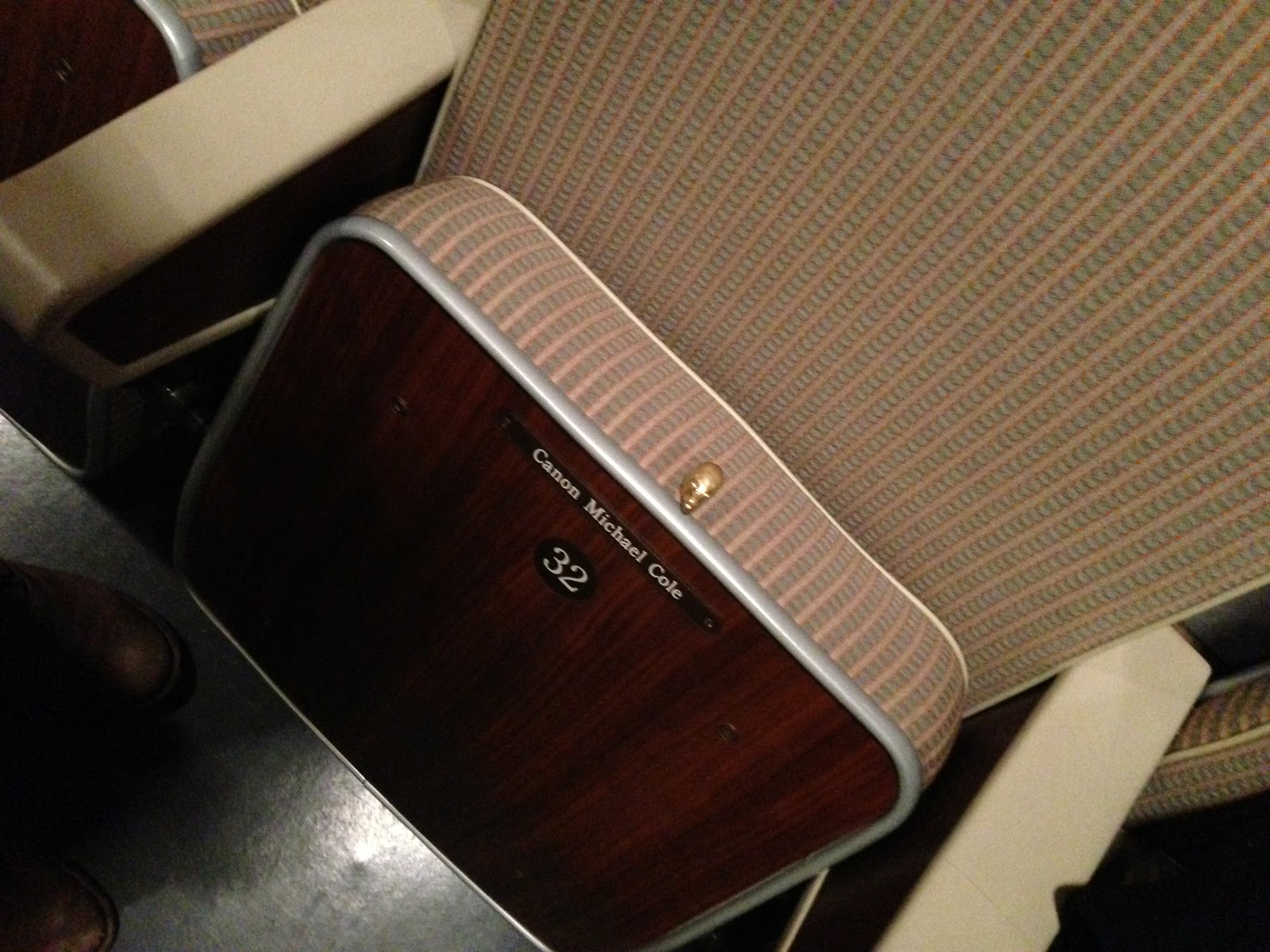
Sure takes the seat next to me

My companions were the ever-entertaining Brother Neil and Charlie (and Sure of course) and we commenced the evening in traditional style at Wagamama’s. The prices at the Southbank branch are hiked to maximise the tourist dollar, but we ordered extra starters anyway, along with the usual 71s (Chicken Katsu Curry) and a Yaki Soba (no 40) for me. Thusly fortified we made our way to the RFH for the first half, which featured a piece none of us had heard before: Grisey’s Quatre Chants pour franchir le seuil (Four Songs for the crossing of the threshold) (Sure). We didn’t buy a programme – ok, so £3 is quite reasonable for such an item I guess, but I wanted to test the theory that you should be able to enjoy music without it being explained for you. In fact the first thing that happened when the reduced forces of the LPO came on stage (there were only about 20 of them) was that maestro Jurowski delivered a speech telling us about the work. It was actually quite interesting. We learned it had been premiered in 1999, in the same venue, and that the composer uses a lot of ‘alternative’ compositional techniques to achieve his soundworld, for example the hiss of a brush run across the skin of a bass drum, and the use of quarter tones, ie notes that exist in between the usual 12 notes of the harmonic scale that most of us recognise in any kind of western music. Jurowski did go on quite a bit about how we should refer to our programme to read the texts that the soprano soloist was going to be singing, emphasising that the work is a ‘meditation on the words, rather than an interpretation of them’. As mentioned, we didn’t have a programme, so I was interested to see whether we’d be able to ‘get’ what was being presented without it.

View from the cheap seats - actually rather good

The piece was bleak. There was no groove or rhythmic hook to get your ears around, and almost no melodies at all. But its quiet delicacy was somehow compelling anyway. I found myself drawing parallels between the sounds the musicians were making and sounds I know from other places: the snare drum at one point sounded like a frantic steam train approaching at a frightening rate; the double bass and bass drum sounded like thunder that is near enough to hear but far enough away for its actual proximity to be ambiguous; and the staccato wind instruments and tapping on the rim of one of the drums sounded like scurrying creepy-crawlies. There were a couple of moments of unexpected tonality – a chord on the harp that was ‘normal’ or an inflection in the vocal that seemed fleetingly to be a tune – but they were gone as soon as they arrived. The soprano soloist was wearing a rather natty fishtail black frock, which was diverting in the more esoteric moments, and was an aid to focus when Brother Neil started very quietly giggling owing to the lyrical content of one part that consisted of the lady singing lots of numbers in French. I was really hoping she wouldn’t come out with it but yes, ‘soixante-neuf’ was in there, which I think was the main culprit in precipitating BN’s temporary loss of composure. The percussionists had a field day, with multiple marimbas, crotales, tom-toms and other instruments at their disposal, including a whole rack of Javanese gongs – massively impressive to look at, though you could hardly hear them when they were played, which was a bit of a shame. Overall it was an interesting piece, though more because it was so hard to understand without any informational pointers. I suppose that’s what your imagination is for though. ‘Bleaker than I expected’ was Brother Neil’s assessment, while Charlie found it ‘soporific’. I liked it.

I don't have time for this

Zzzzzzz

What the hell IS this microtone nonsense?!

View from balcony towards Somerset House

A quick wine at the interval and a little turn about the balcony with its view over the river was quite restorative, though we all agreed that £12.60 for two glasses of the house red was outrageously expensive.

The second half consisted of Austrian composer Gustav Mahler’s 5th Symphony. I’d only heard it once before, and that was on a record, so this was a new experience for me. It’s a pretty epic work – over an hour long and split into five movements (sections). Brother Neil was pleased to inform us that it received its London premiere in October 1945 by the very same orchestra we were hearing perform it tonight. Non-classical experts might know a part of it too – the fourth movement – Adagietto – was famously used in the soundtrack to the 1971 Luchino Visconti film Death in Venice. It provided a good contrast to the first half work, as it’s packed with lush tunes and easy-to-grasp, although quite tragic, emotional sentiments. It starts off with a proper glory moment for the principal trumpet, a funereal fanfare idea, that was really well played by the LPO’s man and which set the tone for what was to come. The whole thing is a bit like the musical equivalent of Tolstoy’s Anna Karenina (which friends of mine know I have read recently and loved) – long, classic, and kind of exhausting to experience, but in a good way. We couldn’t work out why Jurowski had set up the players on the stage in a non-traditional layout – the double basses were on the left as you look at the stage, rather than the right, and the second violins and cellos had swapped places. It didn’t seem to make an awful lot of difference to the sound, but as Charlie pointed out, it was quite cool because you could properly see the basses going for it in a way that you can’t when they’re positioned in the usual place.

The performance was good – lots of life and energy – and the slim, slick-backed-haired Mr Jurowski jumped and skipped about on the podium with a lot of vigour. All of us (including bonus companion Sir Elmlah of the Templar, who we spotted in the first half sitting the choir seats, ie behind the orchestra, and with whom we joined up for a drink afterwards) are fans of the London Symphony Orchestra for their polish and poise, and we did agree that the LPO aren’t quite as good in this regard. There were some moments where they didn’t sound brilliantly together and things became a little blurry, but it’s hard to ruin a piece such as this, and overall their delivery was really very enjoyable. Plus the tickets were only £9 each, and though you’re far away from the stage, the sound in the RFH is great pretty much wherever you are.

We had a swift post-show wine, and Brother Neil had a go on the bicycles that are set up next to the Christmas trees just outside the RFH – the more you pedal, the brighter the fairy lights get! Good fun.

Camp as Christmas? Just kidding.

The 243 and a nice chat with Sir Elmlah of the Templar brought me home to bed and some good long rest that shall hopefully see off the worst of whatever is threatened by the Ailment. All in all, a lovely evening out.

Thursday, 6 December 2012

5: 'Death: A self-portrait' at the Wellcome Collection

183 Euston Road, London, NW1 2BE
www.wellcomecollection.org
Visited on Thursday 6 December 2012


No time for fancy-dan multiple-bus routes today – I was running late for the rendezvous at Euston station with MinusTheMatt, owing to becoming far too absorbed in other project work (making Christmas tree decorations – hm is it a stretch to call that ‘project work’?!). Anyway, suffice it to say, the train from Clapton to Walthamstow and then Victoria line tube to Euston is the quickest route and is quite boring, but I arrived in time to smash a quick whopper meal at Burger King (not my classiest start to a culturecake excursion) and soon we were ready to head over to the Wellcome Collection for the exhibition ‘Death: A self-portrait’.

One great thing about this gallery is that it’s free to go to the permanent collections and all special exhibitions. Another great thing is the facial hair of the founder, Henry Wellcome (1853 – 1936). He was a pharmacist, entrepreneur and philanthropist who amassed a collection of over one million medical items during his lifetime. The Wellcome Building on Euston Road houses the Wellcome Collection, one of three galleries dedicated to this magnificently moustachioed man’s original vision, and its rather pleasing strapline reads ‘The free destination for the incurably curious’. Right up my street then.


Very wise words

‘Death: A self-portrait’ comprises items from the collection of Richard Harris, a former antique print dealer from Chicago, and is devoted to his fascination with our complex and contradictory attitudes towards death. The five rooms were dimly lit, with spotlights strategically positioned to throw eerie shadows on the walls. Throughout, we could hear the murmurings of an interview on repeat being shown on the TV in the final room, featuring Mr Harris himself talking about what inspired him to bring these pieces together. I was very pleased with the free booklet that provides a guide to the exhibition, designed almost in the manner of a funeral order of service book.

Nice, and informative, free thing

Through paintings, sculptures, photographs and drawings from a wide range of artists and ordinary people, Harris took us on a journey through the big philosophical concepts concerning death and dying. We began with a series of vanitas paintings – which I learned is a particular type of symbolic still life from the 16th and 17th centuries, intended to remind the viewer of the transient nature of life on earth. They often include a human skull, juxtaposed with things that we might treasure (money, ornaments, jewellery) or ephemeral items like cut flowers. The message is clear – pretty or ‘valuable’ things last a short time, but death lasts forever. This reminded me of a great verse from the Bible (I once read the whole of the Old Testament) (yes, I know) – ‘No matter how long you live, remember you will be dead much longer’ (Ecclesiastes 11:8). Ecclesiastes was apparently written by ‘The Philosopher’, a man who didn’t really understand the ways of God but gave sensible advice on working hard and enjoying life as best you can given that there isn’t so much of it. It was the most interesting book in the Bible I thought, apart from the ones I knew from the New Testament with the Nativity stories, which are pretty heart-warming.

Anyway, moving on to the second room, we found a series of pieces concerned with the inevitability of death. The notion of the Danse Macabre appeared from the late Medieval period onwards, when Europe was ravaged by wars, famines and plagues. It was represented in all sorts of art, including music, painting and sculpture, and addresses the idea that death is the great leveller – it comes to everyone whether they are popes or paupers, peasants or kings, women or men – but it’s also something of a reveller too. Here were paintings showing skeletons and corpses cavorting with the living, perhaps to remind people that frivolous dancing and self-indulgent behaviour brings you closer to The End. They also offered a humorous perspective and reflected on the absurdity of life. One piece we particularly liked in this room was a little tin and wire sculpture of a skeleton sitting on a table, looking like he was just taking a breather from the party. The works here certainly showed death as something that could be our friend as much as our enemy – whatever the case, it is ever-present and ineluctable.

The third room contained some quite difficult drawings by Goya showing death brought about by war. They are hard to look at not so much because they show dead bodies, but because they show them in such a way that your imagination can’t help supplying the narrative immediately prior to the moment that’s been depicted. The bodies themselves are limp and motionless, but they’ve been brought to that point through horrible violence. A bit depressing.

The fourth room was very interesting, containing a variety of pieces focusing on what Freud described as the ‘eternal conflict at the centre of human civilisation: the instinct towards life and towards destruction’. Many of the works here were both repellent and compelling at the same time. One painting showing a skeleton in an unmistakably sensual pose with a woman was disturbing somehow and yet I couldn’t help looking at it. In the middle of the room was a realistic sculpture of about half a human body – it was missing one leg from the thigh downwards, as well as its bottom jaw and one of its arms. From behind it looked like a man sitting up, but from the front it was a shocking and rather gruesome representation of a human torn apart. Tough stuff!

The final room featured a wide range of pieces focusing on commemoration. It is clear that whatever culture we belong to, we like to feel connected to those who have already died while we ourselves are still alive. There were Tibetan ceremonial bowls from the 1600s made out of human skulls, and photos of modern-day Mexicans posing with wreaths made out of marigolds as part of their Day of the Dead rituals. The items I liked the most were a series of photos taken by anonymous ordinary people, showing groups of the living posing with macabre props such as skeletons or skulls. One of these showed a bunch of what could have been anatomy students with a skeleton, in whose mouth they’d placed a cigar, which was being lit by a leery-looking young man. The photo was dated 1918 – which means that probably all the people in the shot are now as dead as the prop…

After all this, we came to the kind of exit room, on the wall of which there was a huge infographic, specially commissioned from David McCandless. He’s the author and designer of an excellent book called Information is Beautiful, which Brother B Man the Mystic bought me for Christmas a couple of years ago, and which contains graphic representations of all sorts of interesting stats. This one showed the approximate number of people to have died from all the various causes since records began. Cancer and disease were the main culprits – war, jellyfish, Chlamydia and philosophy less so. Interesting. Though perhaps not as interesting as the google search I just did to check ‘is cancer a disease’, as I was unsure as to its medical classification. Hilarious what google thought I might have been looking for, based on me entering the word ‘is’ into the search bar!

The X Factor PR team are all over this issue I'm sure

OK enough of all the death and dying and onto the very live subject of CAKES. I had been advised that the café here is ‘amazing’, but I am afraid to say that we did not find this to be the case (sorry Brother Neil). In its defence, it has a wonderful set of lights above the seating area, which contains nice tables and retro-styled chairs. It’s situated in the entrance hall area of the building and is united in open-plan fashion with the shop, so you can scope out your goods while sipping your tea. Good.

Good lights

Cake with your cellophane?

Not home made

MinusTheMatt opted for a slightly off-programme food selection of pie and beer, while I went for the traditional latte and tart. At £13, this was the cheapest refreshment run of the project so far, but as MTM axiomatically observed: you get what you pay for in this life…

Pork pie with piccalilli and a bottle of Budvar (MinusTheMatt)
“The pastry-to-filling ratio is a bit off. The meat part is not spicy at all, in fact this is the blandest pork pie I’ve ever had in my life. Well below average. I’m going to say this is a 4.5 out of 10. The beer? Well, it’s beer, so yeah fine.”

Treacle tart with latte
“The mug is quite a nice shape, but the coffee tastes a bit machiney. In fact this whole thing has the air of production-line rather than homemade. I am suspicious of the fact that many of the cakes are individually wrapped in cellophane and that the people serving are a bit obsessive about the use of latex gloves. The texture of the tart is a bit claggy, and the whole thing tastes more of lemon than treacle. It’s poor, but I’m hungry so I’ll eat it anyway. Still, 4.5 is the most I can give this.”

The fact that there were no napkins and no forks, added to the above, meant that we were a bit disappointed with the whole café experience. The shop, however, which is in fact a branch of Blackwell’s, was pretty good. I bought the card pictured above showing Henry Wellcome, plus two books – one called ‘Death’ by Geoffrey Scarre, which is about the philosophical questions raised by death, and one called ‘Immortality’ by one of my favourite novelists, Milan Kundera. Good goods.

Apologies for the small number of photos in this post – there were several very clear signs up in the exhibition saying that photography was not allowed. I did get Sure out of my pocket once or twice to look at things, but he didn’t have too much to say.

All in all ‘Death: A self-portrait’ was quite good, but I’m not sure I would really recommend it as a brilliant exhibition to go to. It was certainly thought-provoking, but you could probably just look up ‘images of death’ online if you’re interested and that would get you thinking just as much. I do rate the gallery as a whole though, and there is a lot more to see than the one thing we went too. The fact that it’s totally free is excellent, and I was very pleased with my rather nice booklet.

Wednesday, 5 December 2012

4: Crystal Palace park

Crystal Palace, London, SE19
Visited on Tuesday 4 December 2012


The journey I’d planned for this excursion was intended to be a slightly unusual sight seeing tour that would take in some of the East End, Bermondsey, Peckham, and Upper Norwood – a bit off the beaten tourist track obviously, but a trip through some of the more … practical areas of London. It’s certainly not the quickest way to get to Crystal Palace (it took me 2 hours), but it was pretty interesting. It also afforded the opportunity to see what other people who aren’t at work do on a Tuesday morning, and I’m afraid to say that was a bit bleak in places. The 254 took me from Clapton to Aldgate, via an unexpected diversion down Bethnal Green road. This part was quite cool – there’s a real vibrancy to the area, with lots of shops selling brightly coloured fabrics and sarees, a large range of restaurants and cafes serving Indian, Turkish, and Chinese food, and a general air of rather haphazard energy and optimism.

Boldly going where no brass pig has gone before. Peckham.

The 78 between Aldgate and Peckham was a different story. You pass over Tower Bridge, which still excites me although I’ve lived in London for more than ten years now, but south of the river things take a rather miserable turn. By the time I arrived in Peckham I’d passed numerous shops selling cheap tat, dilapidated-looking housing estates, and everyone on the street looked very unhappy. The wait for the 363 to Crystal Palace was fairly unpleasant too – a gaggle of hooded young men walked into me, and a row broke out between a mother and her son because he wanted to go to Chicken Cottage while she wanted to go to KFC for lunch (more on this subject later). However, I had the rather wonderful Frightened Rabbit on the headphones (a recommendation from today’s companion, MinusTheMatt) and it was lovely and sunny, so my good mood remained undented.

Crystal Palace train station (the rendezvous point) has had a makeover since I was last there, and now houses a rather fancy café off the much-improved ticket hall. Given the extreme cold and time elapsed since breakfast, we decided to kickstart our walk with a coffee and scotch egg, which were a bit pricey but delicious.

Sure only likes the egg bit, obviously

We began with the famous dinosaurs, installed in the park in 1854 by fossil expert Benjamin Waterhouse Hawkins and Richard Owen, who was the founder of the Natural History Museum and coiner of the term ‘dinosaur’. For some reason we’d been expecting some crappy fibreglass monsters, but in fact the pre-historic creatures are represented by some rather beautiful concrete statues, posed in attitudes of hunting and roaring and general dino-conduct. The joke about them is that they are based on contemporary research and fossil analysis and therefore don’t really look much like dinosaurs as we now know them. Even so, they are quite believable as long-extinct lizardy things and have been set very pleasingly on and around a small lake.

Modern beast in foreground, extinct ones behind

Quite beautiful even if inaccurate

Funny lizards on the prowl

After taking some photos and admiring the beasts, we decided to walk around said lake. The modern-day animals and birds are obviously quite used to people – a flock of ducks quacked themselves over to where we paused briefly, clearly hoping we would throw them some bits of food. As we moved away we noticed the reason why the poor buggers might have been so hungry – sitting on the fence, bold as brass, was the fattest squirrel I have ever seen!

Who ate all the nuts Squirrel Nutkin? You did.

The path winds round past the site of the first ever FA Cup Final (now just open grassland) and the National Sports Centre, a sports and leisure complex built in the 1960s and showing its age now. We also came across a curious memorial, which had no information board to explain it, and only by squinting and leaning across the railing could I see that it was a monument to the men of Crystal Palace lost in the First World War. We couldn’t really fathom the significance of the fishes, but I rather liked them – they are the same as those found on the big lampposts along the Embankment in town.

First World War memorial

Majestic

Drive with trees forming an arch

Further on we came to the maze – London’s biggest – and recently done up in honour of the Girl Guides Association, which was founded in this area in the early 20th Century. MinusTheMatt has never been in a maze before, and I think I have only once when I was very little, so we decided to pit our competitive wits against the passageways framed by 3-foot-high hedges, certain that we’d reach the middle pretty easily. Regrettably this was not the case – in fact the damn thing led us on a super-circuitous route to nowhere, eventually spitting us out right where we came in! It was fun though, and thankfully there’s an ‘escape gate’ that you can use to walk straight to the middle section.

We shall win

Moving on, we passed the red oxidised steel concert stage that has apparently become known as the Rusty Laptop. It was built in 1998 but is now pretty much abandoned, which is a great shame – set in the natural bowled amphitheatre of the hill, it would be perfect for summer gigs.

Nobody, playing to an audience of ducks

The last part of our walk through the park brought us to the top of the hill and the site of the Crystal Palace itself. It was originally constructed for the Great Exhibition of 1851 (the success of which funded the V&A, the Natural History Museum and the Science Museum), and was moved here from Hyde Park in 1854. Sadly it burned down in the 1930s and all that remains are the terraces and stone work upon which the spectacular steel and glass structure once stood. It had been a hugely popular venue – the Triennial Handel Festival was held there from 1857, and there were dog shows, brass band contests, dirt-track cycling, a permanent cinema and a firework display every Thursday during the summer. The cause of the fire was never discovered, but it gutted the place within half an hour, despite the best efforts of over 500 firemen. All that remained were the two towers, but these too were dismantled in 1941 lest they provided too conspicuous a landmark to the Enemy. I find this kind of thing somewhat melancholy – the spirit of Victorian adventure, pursuit of knowledge and tendency to erect rather splendid buildings deserves a better memorial than some grassy terraces next to a wind-swept carpark, overlooked by the 219-metre high BBC transmitter tower.

As it was in 1854

As it is now (with multiple patefaci)

There is a café in the park, but it was near the dinosaurs and thusly in the wrong place for our purposes, so we headed to the Crystal Palace triangle in search of refreshments. The Sparrowhawk, a fairly new pub on Westow Hill, provided us with exactly what we desired – a glass of wine to warm up AND cakes. At £19.20, this was a very expensive combination but ohhhhh they were good.

culturewinecake

Apple Crumble Tart with Custard (MinusTheMatt)
“The pastry is pleasingly thin with a good level of crunch, and the custard is creamy and vanilla-y. Very well balanced combination of the apple and the crumble elements. I could take or leave the toffee ice cream but it adds a rather nice cold contrast to the hot tart. This is one of the best versions of this type of cake I’ve ever had. 8 out of 10.”

Vanilla Cheese Cake (thepateface)
“Well I was not expecting this extremely tart raspberry ice cream but it is a rather wonderful foil to the creamy and super-delicious cheesecake. The texture is amazing, and the base is perfect – thin and crunchy and crucially not too greasy. Great balance of flavours. 9 out of 10.”

We were served by a deferential and pleasant young Canadian chap, who I managed to freak out a little bit by rather ostentatiously writing notes about the food in my moleskine. Hehe. The wine served its purpose and we repaired to MTM’s very own palace for some nice chat and a look at the very impressive 3D work he’s recently been doing in his new job.

The route home took me, via the extravagance of a Patebus (aka a taxi, with a most interesting and chatty driver), to Old Street for a nice drink with A of the K in a pub favoured for its miniature Christmas trees and fake snow in the window (of course). 

Sure fashions himself a sort of fake igloo

The final leg involved the 55 to Clapton. There was a great moment when a teenage girl, who was stuffing her face with a box of something extraordinarily malodorous from the Chicken Cottage on Mare Street, said to her male companion “Bruv, what IZ that chick eatin?? It f*ckin stinks man!” Note to self, do not eat humous on a bus again.

All in all it was a lovely day, and I can thoroughly recommend Crystal Palace park as a place to visit. I’m glad I chose it to be part of the culturecake project, since it is so closely connected to several of the project’s other destinations, as mentioned. The park itself is a great place to go in the summer for a picnic, and hopefully one day somebody will come up with a plan to revive the concert stage. 


Monday, 3 December 2012

3: Geffrye Museum


136 Kingsland Road, London, E2 8EA
Visited on Sunday 2 December 2012

Since I moved to Stoke Newington, I have taken the bus to work down the Kingsland Road most weekdays. Once you get through the hectic bottle-neck that is Dalston, the bus stops at a very attractive building called the Geffrye Museum, a converted 18th-century almshouse of the Ironmongers’ Company. It contains a fascinating series of rooms fitted out in the manner of middle-class British living rooms from 1600 to the present day, and calls itself a museum of the home. This visit – to see the Christmas Past exhibition – was prompted by Anna of the Karenina’s penchant for Yuletide happenings and general affection for the season.

Pleasantly simple tree decoration

The layout of the museum is very straightforward, dictated of course by the design of the original building – you walk from one end to the other passing through rooms containing furniture and décor from particular bygone eras. Each one is arranged as a tableau and a little board on an easel describes what’s going on, as if the people who live there have just popped out for a moment. Between these scenes are rooms containing typical museum cabinets of items such as plates, paintings, chairs, lampshades and so on, with interesting information boards. There is a good balance of things to read and things to look at. For the Christmas Past exhibition the curators have adorned each of the rooms with seasonal decorations of the time, and created scenes to depict what would have been happening in them, which also explain the origins of our various festive traditions.

Informative notice

Indeed, comfortable

Sure takes a break

We were immediately struck by how un-Christmassy the rooms from 1600 to the mid 1800s were. This is because most of the things we now associate with Christmas – decorated fir trees, holly, mistletoe, cards and sparkly decorations – only date from the Victorian period. The Christmas tree custom, for example, became popular with the general public following the publication in 1848 of illustrations showing the Royal Family standing around their decorated tree. The actual tradition seems to have come to Britain earlier than that though, imported in the 1780s by Queen Charlotte, George III’s wife, from her native Germany. Christmas cards were invented by an Englishman, Sir Henry Cole, who in 1843 came up with the idea in order to avoid having to write long letters of seasonal greeting to his many business and social contacts. With the introduction of a cheap postage rate for unsealed envelopes and postcards in the 1870s, card sending dramatically increased. It seems the postal system was a little more efficient then than it is today, as apparently when they said ‘post early for Christmas’ they meant ‘get it in the post by Christmas Eve’!

Delighted by the 1850s Christmas vibes

Sure gets involved with the other toys - can you spot him?

The rooms from later periods, particularly those from the decades of the 20th Century, contained items and scenes more familiar to us. In some ways these rooms are more interesting anyway because by the time you get to the 1930s, most of the items you’d find in a living room of today (sofa, bookcases, tv/radio etc) are present, and it’s rather charming to see recognisable pieces in old-fashioned styles.

Mindful that museum visitors require sustenance, the Geffrye Museum people have built a rather good extension to the building, which contains the café. Unfortunately, we arrived too late to sample its goods, though we did have a good look at it and concluded that the crockery is tasteful and the space itself is very pleasant. It smelled of cinnamon and the cakes we were too late to eat looked good! Though it was dark when we were there, the windows all down one side of the room probably afford a rather nice view of the gardens during the daytime. [I told Brother B Man the Mystic about our visit and he said he’d overheard a most interesting conversation on the bus between two ladies who’d been there – apparently the gardener is really helpful and gave some excellent advice on growing herbs out of season].

The last part of the exhibition consisted of a Christmas tree to which we were invited to attach a Christmas wish. Some of these were rather strange: ‘I want to meet more famous people next year’ being my favourite. Sure brought his irrepressible positivity to the proceedings, of course.

Sure can do anything good at all times

Christmas wishes

The shop was not bad – it’s quite small, but had some nice books, and some festive finger puppets, which pleased A of the K. Not as much as her biography though. We both bought nice postcards.

Caption not required

Given that we’d missed out on the café within the museum itself, we decided to go into Shoreditch in search of coffee and cake. This is a fairly fruitless mission at 5pm on a Sunday. Nonetheless, we took a pleasant walk down Brick Lane and through Spitalfields Market, finishing up at Patisserie Valerie. Cakes aplenty, obvs.

Caaaaaaaaaaaaakes

The waitress was pretty grumpy, but we sat in comfortable red leather armchairs while we waited for her to bring us our latte, cappuccino, apple juice and sweet foods.

Post-culture feast

Over-indulged pig

Almond Marzipan cake (Anna of the Karenina)
“Oh my god, I love almonds. The topping is amazing, but hmmm, the inside is a bit, you know, *makes slightly ambiguous hand signal*. There is a questionable layer of jam, and the pastry is a bit dry. But I would still give it a 7 out of 10.”

Apricot Danish (thepateface)
“Very aesthetically pleasing, with an enjoyable layer of icing on top. Very tasty jam within. Slight dryness to the pastry, but it is 6pm and it was probably made this morning, so I will let them off. 7.5 out of 10. Oh wait – having eaten through to the middle section I see they have omitted to place an actual apricot there, the presence of which I had falsely been led to expect following the visible apricots at either end. Slightly vexing. I’m downgrading to a 7 out of 10.”

The coffees were served in very wide cups that were as big as soup bowls (French) and the drinks were pleasant, though not mindblowing. That’s fine. £13.80 for the lot seemed fairly reasonable given the nice ambience and general quality of the goods.

Sure is revived following his sugar overload

On the whole it was agreed that the Geffrye Museum is definitely worth visiting once. We suspected that the café might be a draw in itself, particularly if you’re in the area on a Sunday afternoon and fancy a nice cup of tea and a view of some gardens. It’s probably on the whole more interesting for grown ups than children, and there is a bit of a congestion issue if it’s busy – something that is apparently to be addressed by a £16.3m development project, due for completion in 2015. The museum’s website has some nice photos and a virtual tour. It does also say that although they accommodate corporate events, the building and grounds cannot be hired out for weddings. I know of at least one person reading this who will be disappointed!

Wednesday, 28 November 2012

2: Minnie Birch and Hoodlums at The Social

5 Little Portland Street, London, W1W 7JD
www.thesocial.com
hoodlumsband.com
facebook.com/minniebirch
Visited on Tuesday 27 November 2012


It seems early in the project to be throwing in a bonus event that was not on the schedule, but I guess these are flexible times for me, so here’s a little write-up of the excellent show I went to last night at The Social.

Sure is engrossed

Following two recently cancelled London gigs, I was delighted finally to be going to hear my friend Minnie Birch (aka Emily Jacques). As this was not an official culturecake event, I left Sure at home reading about his kind, and opted for a well-worn rather than adventurously new route into town (train from Clapton, tube to Oxford Circus) (a pleasingly efficient 35 mins). The Social is a small venue on Little Portland Street, and the last time I was there I was actually on the stage – with my band Neon Choir, supporting Brendan Rodgers. I’d never heard Hoodlums before, though one of my companions, MinusTheMatt, strongly suspects that Neon Choir might have supported them many years ago… Anyway, we were to reserve judgment about whether to stick around to hear them, seeing as Miss Jacques was the priority. 

She opened with Sea Shanty, the only one of her songs I knew, having bought it from iTunes. I was amazed by how this unassuming and self-effacing young lady held the room from the very beginning. Her songs are simple and upfront and her voice is sweet as you like. She sings about one night stands (though was careful to point out that she is neither an advocate nor an opponent of such), the boys in her home town of Hemel Hempstead, and good old-fashioned heartbreak, but none of it is clichéd. 

Rather, it is compellingly beautiful, and I was even inspired to whip out my iPhone to write down a lyric at one point (regrettably this might have looked like I was just sending a text) – something about ‘yearning to get lost’, which struck me as quite a lovely notion. The room filled up throughout her set, but she had the audience’s full attention right to the end – modesty, great guitar-playing and a voice that sounds like she’s barely breathing out makes for a pretty damn powerful stage presence. LOVELY.

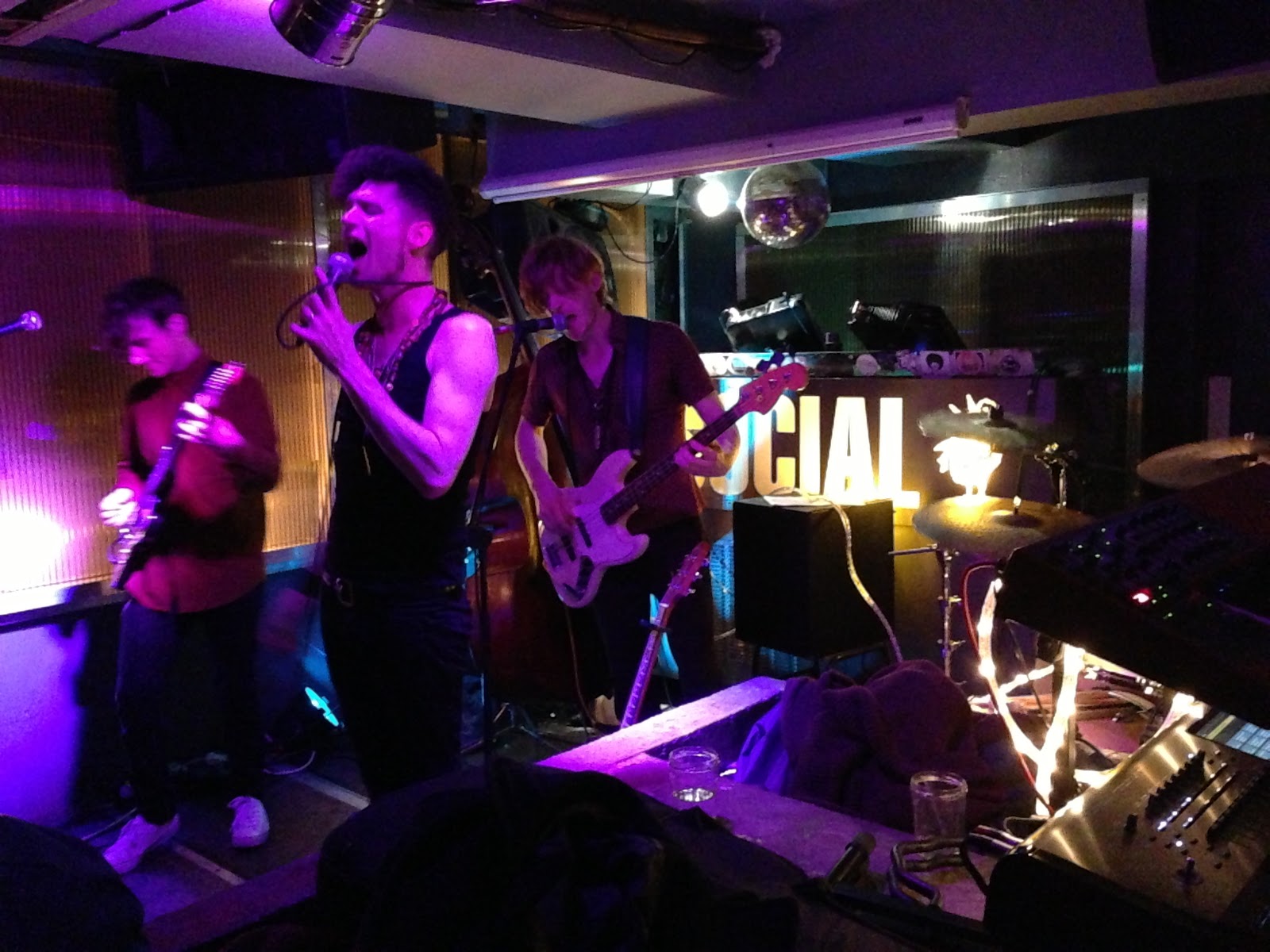
Small stage, big act

Yay for fairy lights

Like the drum dork that I am, I had been eyeing up the Hoodlums’s very nice-looking wooden shell drum kit (you have to walk behind it to get to the ladies’, affording a good opportunity to spy on the gear), which was pleasantly adorned with fairy lights. This also pleased one of my other companions for the night, Anna of the Karenina, who is an ardent fan of anything Christmassy, and we all agreed that the presence of a splendid looking double bass on the stage was promising and thusly that we should stay and see what the band would be like. When the appositely-monikered Lou Vainglorious strutted on to the stage to lead them in their opening number it was clear that this was going to be a very entertaining show! 

From the first song, Mr Vainglorious OWNED the room, clambering over the seating to touch his adoring fans and striking the kinds of poses that you really need to have balls to pull off. The Dalston haircut, skinny jeans, tight vest and beads around the neck all worked, and he’s got one of those great indie voices that transitions from passionate from-the-heart projection to girlie falsetto with impressive ease. There was an amusing moment when he engaged MinusTheMatt in a thumb war mid-song (which I hope MTM had the grace to let him win), and we were only slightly worried about the fact that dear Minnie’s guitar seemed to break his fall a couple of times as he launched himself towards his keyboard player, with the intention of stroking that boy’s head. 

THE DRUMMER was great. Apart from the fact that the kit sounded amazing, his beats drove the whole machine brilliantly and he managed to Go For It without overwhelming the rest of the band (a risk in a venue that small, but you’re in good hands with the very very nice and enthusiastic sound man there). The set list seemed to consist of a string of songs that are destined to be hits (this one is definitely going on my ‘it’s Friday and I’m on my way to the pub after work’ playlist), and the crowd were loving it. Hoodlums are mainly from London, and the brilliant romp Anything Goes, which closed the set, celebrates LV's Southend origins ("God bless the Estuary Boys!"). The uplifting vocal harmonies and big anthemic nature of the tune mean it would probably be better suited to a bigger venue (in fact here’s them doing it at Brixton Academy while supporting Keane on tour this summer), but it worked just fine at The Social and concluded an extremely enjoyable and entertaining gig. The other encore, Four Letter Word, was probably my favourite song of the night, and that, plus all the rest will be on their forthcoming album, due out in Spring 2013, according to their manager, who kindly took the time to reply to my enquiry this morning.

Obvs cake is not really the thing after such an event, so A of the K and I went in search of the customary post-gig kebab. This search was immediately abandoned when we remembered we were on Oxford Street, and so we opted for a filthy McDonald’s instead. I mean, Big Mac meal at 11pm on a Tuesday night, what can I say? A of the K’s food choice addressed the interesting theory of combining sweet (milkshake) with salt (cheeseburger) and it was agreed that this is a most pleasing taste sensation. Marmite chocolate probably represents the zenith of human achievement in this regard, but clearly this is not available in McDonald’s. During a conversation before the show, The Lady Carolina of France had wondered whether McD’s served wine, which we all agreed was a quite French idea, but not a bad one at all.

The homewards route was the same as the outbound one, and I arrived back at the flat feeling that I had been vey pleasantly entertained by the whole evening.  As I reviewed my free gifts from the gig (Minnie Birch badge and very nice business card) I noticed that Sure was still engrossed in the pig book and not at all offended that he’d missed out.
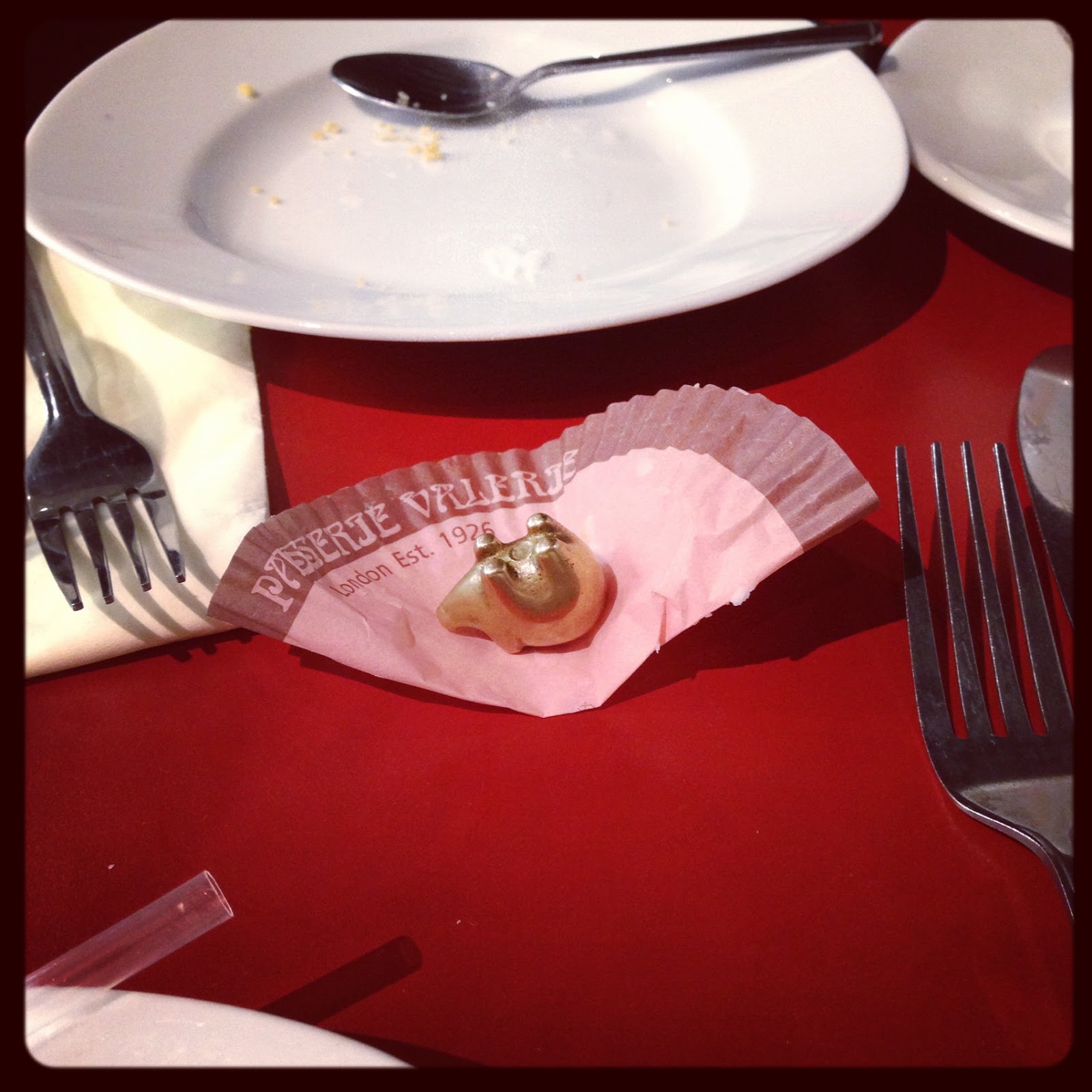
Goods

Thanks to my companions MinusTheMatt, Anna of the Karenina and The Lady C of F for a most lovely evening out.